Showing posts with label PARKER John Davis. Show all posts

Friday, October 24, 2025

Church History Biographical Database

 Church History Biographical Database

Includes 32 of our Early Pioneers


7 Missing from Database

Died before and in Nauvoo, and on the trail.

1839 joined Michigan - Adaline RAWSON 1811-1841 Nauvoo
(1844) joined Engalnd - William INGRAM 1790-1844 St Louis
(1844) joined Engalnd - Susannah GRIFFITHS 1811-1844 St Louis
1841 joined Engalnd - Daniel William SMITH 1792-1845 Nauvoo
1844 joined Massachusetts - Horace Datus ENSIGN 1797-1846 Winter Quarters


Arrived in Deseret 1869,
 they sent ahead, four teenage children who had been born in the Church,

1848 joined Engalnd - Henry WORLEY 1827-1914
1848 joined Engalnd - Catherine WILLMORE 


Monday, September 15, 2025

John Davis PARKER (1799-1891)

John Davis Parker (1799-1891)


  • Veteran of the War of 1812
  • Veteran of Zion's Camp (1834)
  • Missionary
  • Deputy Sheriff of Hancock county, Illinois 
  • Captain in the Nauvoo Legion
  • Sheriff of Pottawattamie County, Iowa. 
  • Bishop Shadrach Roundy's assistent Winter Quarters 5th Ward
  • Utah Pioneer
  • Sheriff Salt Lake County.
  • 2 terms Utah State Legislature
  • 2 terms Utah Assessor and Collector
Born: 22 Nov 1799, Saratoga Twp, Saratoga, New York. Oldest of 15 children

Died: 27 Feb 1891, Kanarraville, Iron, Utah


SeeFandom familypedia: Most of this is quoted from familypedia, aditions and corrections added :

[John D. PARKER] Zions Camp Participant

One of the most interesting episodes in the early history of [The Church of Jesus christ of Latter Day Saints] was the march of Zion's Camp (1834). The members of the Church in Missouri were being persecuted, and the Prophet Joseph made it a matter of prayer and received a revelation on February 24, 1834. The Lord instructed the Prophet to assemble at least one hundred young and middle-aged men and to go to the land of Zion, or Missouri. (See D&C 130:19-34.)

Zion’s Camp, a group of approximately one hundred and fifty men, gathered at Kirtland Ohio, in the spring of 1834 and marched to jacson County Missouri. By the time they reached Missouri, the camp had increased to approximately two hundred men.  

[Baptized 1 May 1832 by Shadrach Roundy and Steven Burnett.] Parker [was] an early convert to the Church for by 1834 he was a member of the Zion's Camp mission to relieve the suffering saints in Missouri. The History of the Church records: "Among the most active of those who were engaged in taking care of the sick at the [Zion's] Camp, burying the dead, etc., were John D. Parker, John Tanner, Nathan Tanner, Joseph B. Noble, Brigham Young, Joseph Young, Heber C. Kimball, Luke S. Johnson and Eleazar Miller."

Possibly because of the faithfulness demonstrated by Elder Parker during Zion's Camp he was named a year later in 1835 as a member of the First Quorum of the Seventy placing him among the ranks of the General Authorities.

He served with Wilford Woodruff in Zion's Camp in 1834, and he spoke in meetings which Wilford Woodruff attended about 1878 in Utah Territory (See: Wilford Woodruff Papers.)

Missionary Labors

In 1841, he was named in a special conference as a missionary to serve in New Orleans, Louisiana. By 1842 he was back in Nauvoo, Illinois where the Prophet Joseph Smith wrote: These are not the only ones who have administered to my necessity and whom the Lord will bless. There is Brother John D. Parker ... My heart feels to reciprocate the unwearied kindnesses that have been bestowed upon me by these men. They are men of noble stature, of noble hands, and of noble deeds; possessing noble, and daring, and giant hearts and souls.

[Winter Quarters 5th Ward
Source part: image 37  
official bishop's report of members, Dec 16 1846, "Ward No. 5, Block No.26." Bishop Shadrach Roundy, assistants John D. Parker, Elias Gardner, clerk James Sloan]

[John Davis PARKER] Lawman

Elder Parker seems to have been close to the prophet. He served as one of the Prophet's bodyguards and often accompanied him on trips seeking refuge. He was also a lawman, serving as a Deputy Sheriff in Hancock County, Illinois during the Nauvoo era and as Sheriff in Pottawattamie County, Iowa during the exodus west. In September 1842, the Prophet wrote: " I accompanied the brethren and Emma to my house, remaining there a few minutes to offer a blessing upon the heads of my sleeping children; then called a few minutes at the house of my cousin George A. Smith, on my way to my retreat at Edward Hunter's. John D. Parker accompanied me as guard.

He also served as an officer in the Nauvoo Legion, at the time the largest single military unit in the United Stated and at its peak numbering a force almost half as large as the entire regular United States Army. He was, in fact, one of the organizers. From the History of the Church Vol.4, Ch.15, page 295: "Minutes of the Meeting which Organized the Nauvoo Legion. "Pursuant to an ordinance of the City Council of the City of Nauvoo, entitled, "An ordinance organizing the Nauvoo Legion," passed February 3, 1841, a court-martial, composed of the commissioned officers of the militia of the state of Illinois, within the city of Nauvoo, assembled at the office of Joseph Smith, on Thursday at 10 o'clock a.m., the 4th day of February, 1841: present--John C. Bennett, quarter-master general of the state of Illinois; Lieutenant-Colonel Don Carlos Smith; Captains Charles C. Rich, Wilson Law, Albert P. Rockwood, William Law, Titus Billings, Stephen Markham; first lieutenants, Francis M. Higbee, John T. Barnett, John D. Parker." Also read the following: "Saturday, 24.SEP 1842--The legion was called out for general parade, and reviewed by General Law. In the evening, Lieutenant-Colonel Stephen Markham was elected Colonel of the 1st Regiment, 1st Cohort, to fill the place of Colonel George Miller, promoted; and Captain John D. Parker elected to fill his place; and Captain Thomas Rich to fill the place of Major Wightman, deceased.


As a lawman, Elder Parker on at least one occasion had to arrest the Prophet himself. Whether this was a ploy to keep mobocrat lawmen from arresting the Prophet or merely enforcing a legally issued but ultimately bogus writ of arrest is not certain. The verbiage makes the second seem more likely. On. Monday, May 6, 1844, the Prophet wrote: "I had a warrant served on me by John D. Parker, issued by the clerk of the circuit court of Carthage, on the complaint of Francis M. Higbee, who had laid his damages at $5,000. but for what the writ does not state. I petitioned the municipal court for a writ of habeas corpus which I obtained."

After the prophet's martyrdom, Elder Parker was on October 11, 1845 appointed captain of the eleventh company for the trek west. Elder Parker maintained a closeness with the presiding brethren of the Church after the saints west west. As the saints faced increasing difficulties over the practice of plural marriage. Brigham Young determined to meet the legal challenges. He started a winter trip to face a Federal Magistrate. It is recorded: "December 1872, The second day's journey brought them to Kanarra, in Iron county. Here they met the veteran life guard of the Prophet Joseph Smith, John D. Parker, "who wept like a child because President Young was going back to face his enemies in the court room, which he considered an act of madness."

Married Three Times 

.... 
The ProphetJoseph SMITH  recorded on January 8, 1844, "At eleven went to my office to investigate a difficulty between John D. Parker and his wife. After laboring with them about two hours, brought about a reconciliation."

First marriage ended in divorce before 1846. She remarried by 1862 when Harriett Sherwood remarried in Morgan County, IL.



Spouse /
partner: (1)

Harriett Sherwood (1806-1880). She was deaf. Five Children, all died young. 

Wedding (1):

Spouse /
partner (2):

Almeda Sophia Roundy (1829-1912). 29 years younger than Husband. Ten Children , five died young.

Wedding (2):

Spouse /
partner (3):

Wedding (3):


Tuesday, May 23, 2017

Latter-day Saint Missionaries in the Family


I will begin to record family members who have served missions for the Church of Jesus Christ of Latter-day Saints. Listed by year called with the exception of multiple missions served by one person, and siblings.

Simeon Adams DUNN (1803-1883)
Served several Missions
 
  • September, 1841, I was sent to West Canada, on a mission to preach the gospel.
  • 1843 Warren County, Illinois
  • April, 1844 I was ordained one of the Seventies, under the hands of Levi Hancock. In May 1844 I was sent on a mission to the State of New York, to advocate the Prophet's claim to the Presidency of the United States of America.
  • We [as a family] arrived [in Salt Lake City] September 28,1848. I remained there until I was called to go to the South Sea Isles, On May 7, 1850 I set off on a mission to the South Pacific Sea Isles.
  • October 19, 1871, I left Brigham City for the States, on a mission to look up the genealogy of my dead friends, which proved to be a very successful mission. I returned home the 19th of July, 1874, having traveled 10,0000 miles on rail and on the U.S.Seal.
  • November 1, 1877, I was privileged with a mission to St. George, Utah, to officiate for my dead in the Holy Temple of our God. January 27, 1878 returned home. 


John Davis PARKER (1977-1891)
Zions Camp.
Member First Quorum of Seventy
1841 New Orleans, Louisiana


Shadrach ROUNDY (1789-1872)
Member Second Quorum of Seventy

  • 1844 unknown mission - called during Gen. Conf. at Nauvoo.
  • 1849 East


William Reese DAVIES (1805-1865) after being the first man baptized in South Wales 17 Feb 1843 he was the first Welsh speaking missionary. His wife Rachel MORRIS (1803-1882) had been the first woman baptized in South Wales 19 Feb 1843.  She supported the family while William was away in the Lord's service.

  • 1843 South Wales being the first missionary to teach in the Welsh language. 

Son of William Reese DAVIES (1805-1865) and Rachel MORRIS (1803-1882).
James George DAVIS (1832-1909)

  • abt 1852 he filled a mission among the Navajo Indians.  He learned the Navajo language.


Martin Luther ENSIGN (1831-1911)
1857 Handcart Mission to Great Britain
          He left his wife Mary DUNN (married 1852) and three daughters to serve mission.


Three sons of Samuel SMITH (1818-1897)
          son of Samuel Jane INGRAM SMITH
Isaac SMITH (1857-1914)
1878 Great Britain and the Isle of Mann.
          His wife Harriet Camilla ENSIGN (married 1877) sold everything they had to support his mission and give birth to their first child while he was gone.


          son of Samuel and Janett Maria SMITH SMITH
Ernest Carlos SMITH (1875-1927)
1898 British Mission


      son of Samuel and Janett Maria SMITH SMITH
James George SMITH (1865-1934)
1901 British Mission
Married age 33 - wife Mary Louise GILBERT (Married 1885)


Two sons of Henry WORLEY (1827-1914) and Catherine WHILMORE (1822-1904).
Harry WORLEY
1890 Great Britain

William John WORLEY
1925 Southern States


Son of Martin Luther ENSIGN (1831-1911) and Mary DUNN (1833-1920).
Adams Wesley ENSIGN
1896 Southern States


Admas Wesley and his nephew Isaac Samuel SMITH in Johnson City, Tennessee Southern, States Mission.


Three sons of Isaac SMITH (1857-1914) and Harriet Camilla ENSIGN (1859-1930).
Isaac Samuel SMITH
1897 Southern States


Isaac Samuel SMITH served some of his mission in London, England (or possibly a second mission to England)


William Richard SMITH
1906 Swiss and German


Wesley Ensign SMITH
1909 Northern States


Two sons of Isaac SMITH (1857-1914) and Elizabeth FUHRIMAN (1871-1944).
Jacob Isaac SMITH 
1919 New Zealand


Welland Fuhriman SMTIH
1929 Northern States


Son of John WOOD Jr. and Sarah Ann GIBSON
Ether WOOD
1909 Colorado


Son of Frances HAWKES and Eliza COLE 
Clarence Christopher CRESSELL HAWKES (1861-1949)
1892 British Mission
Left family to serve mission. Wife Mary Ann FARNES (married 1886) and four children a fifth child born he was while away.


Four sons of 
Herbert Henry HAWKES (1869-1948) and Sarah Amy JONES (1875-1952).
Herbert Jones HAWKES
1922 Mexico


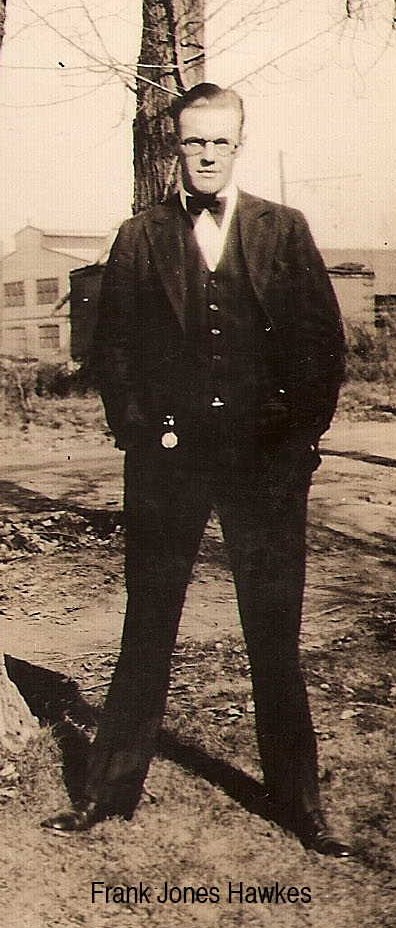
Frank Jones HAWKES
1926 Eastern States


  • abt 1988 Frank HAWKES and his wife Minnie Ann NIELSEN served a mission.  
Lorin Jones HAWKES
(Bishop)
1934 France. [30 month Mission in France Released June 1937.]

  • 1981-83 Montreal Canada French speaking mission with his wife Neva Roundy CARDON.
Blayne Jones HAWKES
1941 California


Modern missions served by family to be added.


Friday, March 6, 2015

Together Again - John Davis PARKER


Note: John Davis PARKER was member of Zions Camp and a member of the First Quorum of SeventyJohn D. PARKER  joined the Council of Fifty prior to June 27, 1844, under the leadership of Joseph Smith, President of the Church of Jesus Christ of Latter Day Saints (as named in 1844). 

[Wives: 
1- Harriet SHERWOOD married before 1834 divorced before 1846. They had  4 children all died young.  Harriet was born 31 Jan 1806 and died 1881 IL.  She was deaf.  See: Church History. She was the daughter of Henry Garlic SHERWOOD. See: familysearch.org 

2 - Almeda Sophia ROUNDY married 3 Feb 1846 in the Nauvoo Temple, IL. Sophia was the daughter of Shadrack ROUNDY and Betsey QUIMBY.  They had 10 children.  Sophia was born 7 Mar 1829 NY and died 25 Sep 1912 UT.

3- Samantha ROUNDY married 3 Feb 1846 in the Nauvoo Temple, IL.  Samantha was the daughter of Shadrach ROUNDY and Betsey QUIMBY.  They had no children.  Samantha was born 2 Jun 1824 in NY and died 12 Jul 1906 in UT.

John D. PARKER, Sophia and Samantha all buried in Kanarraville, UT]

John Davis Parker
By Sophia Parker Stapley
As you can tell from all of the events credited to him, Grandfather Parker was an active and responsible man. He lived a full and exciting life. As has already been noted, he was born in Saratoga, New York as the first of 15 children. Because the family was so large, he was raised by a "German Aunt" (we're not sure who this was) and received a good education. He learned to speak seven different languages, four of which he mastered. This education was to serve him well in the years to come.

But he was restless, even as a youngster. At the age of only 13, he enlisted in the Army and became a soldier in the War of 1812! And served a full term, to boot. He was still restless after that, even though his aunt wanted him to stay with her. She was even willing to leave him her property and a large library of valuable books, if he would stay. But it wasn't what he wanted. He left home and at 17 years of age was working in a lumber business near Montreal, moving later to Nauvoo, Illinois. He became skilled in making wagons. The Latter Day Saints were located at Nauvoo at the time, and he came to know their leaders and their mission well. He embraced the Gospel and was baptized on May 1, 1832, by Shadrach Roundy and Steven Burnett. He was a member of the first Seventy Quorum in March, 1835; received the Patriarchal Blessing from the father of Prophet Joseph Smith in 1836; became an Elder on January 3, 1841; filled a Mission; and became a High Priest of the Church.

At Nauvoo, he met and married a Harriet Sherwood, who was deaf and dumb. They had four children, all of whom died in infancy -- named Dorcus, Moroni, Nephi, and Samuel. They later divorced.

Also at this time he became a commissioned officer, a Captain of the Militia of the State of Illinois, Nauvoo Legion, in 1842; and was elected a constable in Nauvoo in 1843. It was during this time that he began to play his important role of being a bodyguard for the Prophet. There are many stories about his deeds, doing this. I already told you about how he had gained the confidence of Sheriff John Williams, my great-grandfather, to learn of the plans the mobs had for threatening harm to the Latter Day Saints. He did this unbeknownst to the Sheriff, and used this secret information to help move the Prophet from one safe place to another. One night in particular, when danger seemed greatest, he "borrowed" a horse from a neighbor, silently crossed a river, moved the Prophet and his brother Hyrum to a safer place, came back across the river, and returned the horse to its proper place. The mob didn't find the Prophet when they made their raid that night and the family never knew that their horse had taken part in such an adventure.

Brigham Young appointed him to watch the Movements of the mob, and to stay the violence in Ward Carthage. Both he and Shadrach Roundy were selected by the Council to help move families and their goods from there into Nauvoo, for safer haven. It was daring and dangerous work and they responded to their mission. As you know, the Prophet and his brother were both killed by the mob, anyway, despite the efforts to protect them. The Prophet came out of hiding when he felt his people needed him, was jailed, and then killed while in jail. It was a terrible deed.

It was at Nauvoo that Grandfather Parker met two of the Roundy sisters, Almeda Sophia and Samantha, daughters of Shadrach. Following a courtship, he married them both in the Nauvoo Temple on February 3, 1846. It was a polygamous marriage, which was practiced in the Church at that time (the practice ended with the Manifesto in 1885).

When the decision was made in 1847 for the Latter Day Saints to move from Nauvoo to Utah, he and his wives were ready to join the first Company. But because he had become such a good wagon-maker, he was asked by Brigham Young to make wagons for others to use in crossing the Plains. They moved to a safer place -- the "Winter Camp" in Kanesville, Pottowami County, Iowa -- for this purpose, ending up spending about five years there. While he was there, the first three of his children were born. The first one died at birth, which brought great sorrow to them. He also served a term as County Sheriff. In all, he made 13 wagons that crossed the Plains. Then his shop caught fire, destroying two other wagons and his tools. Shortly afterwards, they decided it was time for them to make the journey to Utah also. Shortly afterwards, they decided it was time for them to make the journey to Utah Also.

To make the trip, they joined the Company of Captain Abraham D. Smoot. It was a terrible journey, because of a "scourge" (cholera) which struck many members of the Company. In all, 68 became sick and 14 died. Those who were stricken with it got it suddenly and were very ill. Those who didn't get it tried to take care of those who were sick. The weather was hot, and for those who died there was no time to make coffins. They were wrapped in their blankets and buried on the prairie. Every known method of combating the disease was tried. One method that seemed to work best was this. The afflicted person was either dipped in cool water or had it poured over the body. Then a starch-like mixture was made of whiskey and flour, and administered by mouth. Most of them made it through. Heading the list of those credited with doing their utmost to care for the sick was Grandfather Parker. The list also included Brigham Young, John Tanner, Nathan Tanner, and Heber C. Kimball. They arrived in Utah on August 28, 1852, with the five members of their family, a wagon, four oxen and two cows. They first settled in Centerville, Morgan County, and my father Charles was born there the following year, on December 30, 1853.

Grandfather's good education helped him become a leader among the early settlers of Utah. While living in Centerville, he was elected to two terms in the State Legislature, and one as a Probate Judge. His family and others were then called on to help settle Kanab, Cane County, Utah; and then later they moved to Kanarra in Iron County.

His fighting days were not over though. He fought during the Civil War of 1861-1965, when he was in his 60's, with a sword no less! It may have been the same sword he owned that had been a relic of the Revolutionary War. He cherished that sword. Anyway, after that he served in the Madisonian War to gain the right to naturalize.

Esther had a nice closing to grandfather's story. Here is how she tells it:
My grandparents lived in Kanab and from there they moved to Kanarra (North), the original location of the town, then to the new town after it was moved and rebuilt. They built a log cabin on the N.E. corner lot, of the block which stands N.E. corner lot, of the block which stands N.E. from the Church square, where Brother Platt's garden now stands. The family was raised in the log cabin. Later they bought a new home from Doc Brown.

They were a devoted family. Grandpa displayed many acts of kindness to both of his wives; also to his daughter-in-law, Elizabeth, to whom he was very devoted, after his son Charles was married. Their warm affection and devotion lasted throughout their lives. At the time when the Marshals came on their rounds in search for Polygamists, grandpa talked with them but never was taken.

Because grandpa was quite old when he began raising his family (48) most of the responsibility of caring for the family fell on Charles' shoulders. Grandpa was 54 when Charles was born and 73 when his last daughter, Samantha was born. Charles then was nineteen years old. Grandpa did all he could to carry his load, such as chopping wood, shucking corn, feeding the stock, etc. But Grandma did the gardening. Charles did all the farming and hauling wood.

Grandpa was not too thrifty, that is, he didn't save very much money; however, he always managed to pay his full amount of tithing to the Church and was forever a very faithful member, always helping the other less fortunate families, especially the needy widowed families.
His lifelong habit of snuffing and chewing tobacco was broken during the last years of his life. He was often seen cracking and eating the pits from the Pottowomi plums, which could have been his means of substituting something else to help himself break his tobacco habit. I was only five years old when grandpa died but I do often remember seeing him sitting in his chair by the stove, enjoying the warm wood fire that heated the house. By his side was a little stool, on which his cat sat, sharing this comfortable place. They looked so contented warming themselves and napping there together. During that last cold winter, Grandpa developed pneumonia. He was then ninety-two. He went outside to cut his last armful of wood and as he entered the house he said that he would not ever be cutting any more wood. He went to his chair by the fire, and it was there where he took his final nap. He died in his favorite chair, with Kitty curled at his side.

Wednesday, October 15, 2014

Grandfathers in the First and Second Quorums of Seventy

First Quorum of Seventy- John Davis PARKER [see the first column]

Ancestry Chain:  John Davis PARKER 1799-1891, Charles PARKER 1853-1935, Laura Elizabeth PARKER 1889-1970 , Kirt DeMar WOOD 1923-1987, Lark, TR. 

Second Quorum of Seventy - Shadrach ROUNDY [see the first column]

Ancestry Chain: Shardrach ROUNDY 1789-1872, Almeda Sophia ROUNDY 1829-1912, Charles PARKER 1853-1935, Laura Elizabeth PARKER 1889-1970 , Kirt DeMar WOOD 1923-1987, Lark, TR. 


Same two Grandfathers in the Council of Fifty:
John D. PARKER joined (19 Mar 1844) the Council of Fifty prior to June 27, 1844, under the leadership of Joseph Smith. Later released do to Old age.

Shadrach ROUNDY joined (1 Mar 1845) the Council of Fifty following after June 27, 1844, and under the leadership of Brigham Young. Died 4 Jul 1872.

Sunday, November 25, 2012

PARKER John D Pension War1812


PARKER, John D Pension War 1812
WAR OF 1812
WO. 45224
SOLDIER: Parker, John Davis 
WIDOW: PARKER, Almeda Sophia
SERVICE: Teamster General Wool's Command NY Mil


Able PARKER's 4 horse team was "pressed" into service for Maj. Wool.  [John E. Wool was not a General until the Civil War.]  John d. Stepped up and volunteered to drive the wagon.  On 15 June 1813 at the age of 13 John Davis PARKER signed up to serve as a teamster at Greenbush, New York.  He served a full eighteen months.  

Description of John Davis PARKER: about 5 feet tall with black hair, blue eyes, and having a dark complexion at the time he signed up to drive the wagon. 

Ancestry Chain: TR, Lark, Kirt DeMar WOOD 1923-1987, Laura Elizabeth PARKER 1889-1971, Charles PARKER 1853-1935, John Davis PARKER 1799-1891. 


Tuesday, November 2, 2010

Betsy Jane PARKER SMITH

Betsy Jane PARKER wife of John George SMITH
written Mrs. Earl Smith in 1942
Dear Children,
I am writing this letter to give you some truths and dates concerning your Grandmother Smith’s life. I am writing now while she is still with us that she can give me the important things from her own memory which is very excellent. I also write this for anyone who may be interested in the life of a Southern Utah pioneer, and also our only living Kanarra Pioneer. I do hope that the lovely thoughts that are written here you shall always keep in your memory and cherish as something beautiful.
Mrs. Earl Smith

-------------------------------------
John Davis PARKER (1799-1891)
Almeda Sophia ROUNDY (1829-1912)

Betsy Jane Parker Smith - Born March 20, 1859 at Centerville Davis County. She was the daughter of two of the faithful pioneers, John [Davis] Parker and [Almeda Sophia] Roundy, who crossed the plains and came to Salt Lake Valley. Great gradnfather Parker was a polygamist.

Grandma [
Betsy Jane Parker Smith] lived in Centerville until she was six years old, and then the family moved to Levan, stayed two years there, then when she was eight years old they moved south. At that time Brigham Young was calling families to settle other communities farther south, and he told Lorenzo Roundy, that was Grand’s uncle [Lorenzo was Almeda Sophia Roundy's brother], to select another family and move to Kanab. Brother Roundy came from Centerville on down to Levan and ask John Parker to go. I think the family wanted to wait until spring, as this was late fall, but they were influenced to leave as soon as they could pack and get started.

Charles PARKER (1853-1935)

Brother Roundy had his two wives and their families; they were Susannah and Priscilla also two young men to drive the stock. These men were William Ford and Byron Roundy and his son Wallace. Grandma’s oldest brother [John Davis PARKER Jr.] accompanied them to help drive. These people went on ahead and grandma came on later with the rest of the family and persons.
They had ox team and a team of horses. Her brother Charles
[PARKER] was only fourteen then and drove the horse team all the way.

When the family arrived at Beaver, Grandma [Betsey Jane PARKER] and a younger brother [Otho PARKER] got scarlet fever but they never stopped but came on with their sick in the wagon bed. They were sick all the way. They arrived at Toquerville Christmas eve. What a lovely Christmas Eve they must have had. Richard Higbee took them to his home to camp. The next day Christmas they drove on to Kanab. Lorenzo Roundy was informed where they were and he sent William Ford and Grandma’s brother out to meet them with another team.
Reaching their destination, they found one log room, the sick were placed there, and the rest were in tents and covered wagons. Brother Roundy also had children with Scarlet Fever. That same night Grandma’s little brother
[Otho PARKER] died, a few days later her sister [Mary Ellen PARKER], and Brother Roundy’s little girl died. Brother Roundy who was my great, Grandfather made three caskets from a wagon box and the graves were all dug under a pine tree.

The Indians were so mean at that time they didn’t know how soon they would have to leave those three lonely graves. The Indians were raiding all the time driving off the cattle and horses. They had that fear when they went to bed at night of being massacred before morning. Grandma can still remember the feeling that went over her when the word came that two Berry Brothers [Joseph Smith and Robert Matison BERRY] had been killed [2 Apr 1866], and the Indians not so very far from where they were camped had killed a man named Whitmore. They finally decided they couldn’t risk their lives any longer and went from Kanab to Long Valley in the spring where they planted crops, but the Indians were always on the warpath. Then in the summer they were called to come to Kanarra.
They left crops and shelters and arrived here the 3rd of July. They camped down in the meadow by what we call Billy Young Spring.

Bishop Lorenzo Wesley ROUNDY (1819-1876)
[Bishop Roundy drowned in the Colorado River while exploring new territory for the Prophet Brigham Young.]

Lorenzo Roundy, your great Grandfather was chosen Bishop, and he started right away to plan a fort [Kanarraville]. It was built around what we know as the public square. They started right away to build the fort to protect them from the Indians. By fall of that year the people of Kanarra moved in and joined the fort. It was necessary because of so much sand out where they were living (to the north) and also they combined their towns to be protected from the Indians. That’s the reason for building in the form of a fort. One night shortly after this, an old Piute Indian, a friend to the settlers brought word, the Navajos were making a raid on the settlement of Kanarra and Harmony that night. The Bishop asked for volunteers to ride and warn Harmony residents. Grandma’s brother Charles PARKER] [volunteered to go, he was fifteen years old. James Woolsey said “He isn’t going alone, I shall go with him.” Can you imagine his Mothers feelings until he was back safely? The next fall some of the men went back to Long Valley to gather some of the crops that [were] planted the previous year. They filled their wagon boxes and on the way back Indians attacked them. An arrow hit into a tree that William Berry was standing by. The men had to leave their loads and come on with their horses.

The following spring in February another brother [John Davis PARKER Jr.] died of Typhoid Fever. He was nineteen years old.
There was only log room and the dead had to be put outside before burial. A baby sister, [Almeda] Sophia [PARKER] was born, just one week after his death.

They lived in a fort before they started to branch out and build
on lots that had been planned and laid out. At that time food was very scarce, but Grandma’s father [John Davis PARKER] was one of the best financially fixed men. Their usual diet was whole grain meal and eggs, vegetables, mostly potatoes, milk and its products, some fruit. Food was scarce on account of water being scarce. Clothing was scarce, it was all-handmade. Grandma says she can well remember sitting out in the moon light by the side of her mother [Almeda Sophia ROUNDY] to knit their stockings because they had no candles and it was too warm for a fire to light their wood.


Even in this day the Mormon settlers strived for an education. Yet anyone given the chance to go to school very many years were thought fortunate. Parents so much per child taught paid the school teachers personally.
So Grandma considered herself very fortunate. Her parents wanted her to have an education and she went to school. Here last teacher was an English man named Shoppman. She was then eighteen years old when she graduated and took her exam in Toquerville, which was the county seat. Kanarra was in Kane County then. [Kanarra became part of Iron County].

Grandma taught school in Kanarra about two years. Then John [George] Smith from Salt Lake came here hunting work, and started showing her attention. He was somewhat older that she, but that didn’t seem to be a draw back. John Smith had volunteered to fight the Black Hawk Indians when he was seventeen. He was a carpenter by trade and a very efficient one. He worked on the Salt Lake Tabernacle. He made many caskets after that trimmed them and all.
David J. Cannon married Betsy and John in the St. George Temple on March 12, 1880. Then they went to Escalante in Garfield County; lived there for a short time then went back to Grandpa’s hometown Salt Lake. They stayed there for sever years then came back to Kanarra. Their first child was born after they moved back here. They had seven children two girls and five boys. Their oldest boy died when he was thirteen years old his name was Sam. He died in February, and in April another boy was born, this was your dad. He was born April 30, 1899.

Grandpa [John Davis] Parker made the shoes for his family. There was tannery in Parowan at that time. He would get his leather all ready, cut out the shoes, and use wooden pegs to put their soles on with. These pegs were made of hard wood as Locust tree wood. They were put in dry and when they were wet, they would swell and never come out of the shoes. Grandma Smith [Betsey Jane PARKER] never had to go barefoot like lots of the pioneers did. Grandma was blessed by having parents who strictly obeyed the law of tithing. They would have paid their tithing if they hadn’t had anything left to eat.
Grandma says maybe that was the reason they always had food. She was so impressed with this law her family always observed it. She has always donated for any worthy cause. She was always a very faithful church member, always attending until the few recent years. She has been a Relief Society member, worked as a block teacher and was also secretary. She made a very efficient secretary. She took a special course in bookkeeping when she was preparing to be a teach. She is an honorary member now. She is the oldest member in our Relief Society. She attended the Opening Social March 17, 1941 when she was nearing her eighty third birthday. When the weather permits she walks as far as a block everyday. Aunt Bet, as she has been known here in Kanarra, she had been a most faithful one in calling on the sick and homebound. Always sympathizing with those who were looked down on by some or who were not as fortunate as she. One thing not to be forgotten is the fact she was our very best humorous writer. When there was need of something of wit or humor and that was often. Always they could call on “Aunt Bet”, she still has that spirit though she has had many sorrows. She lost three sons, one dying of snakebite, also lost one grown grandson and one baby granddaughter. Both daughters and one son married. She has had eight grand children two of them are married. Grandpa
[John George SMITH] died twelve years ago (1929) at the age of eighty-five. Grandma is still able to work, since she was eighty years old she has pieced by hand four scrap quilts, very beautiful work. She gave one to each of her grand daughters and one to her married grandson. Mignon and Yvonne, you should surely prize those quilts. Grandma’s neighbors and she has had quite a few, has remarked that she has always been cheerful and kind to her family, never once had they heard her scold or spank her children, and you know that from the way she has treated her grown children, and as far as being a good mother-in-law my own parents could never have treated me more as a daughter should be treated, that Grandpa and Grandma Smith and I’m thankful for that.

Grandma’s father
[John Davis Parker] was one of Joseph Smith’s bodyguards at the time of the persecutions of the Saints. Some of the relics Grandma has are as follows: a small tin horse that belonged to her brother the one that died when they first arrived in Kanab. Her books she used when she was teaching school. A picture of Grandpa in his War uniform. The money her oldest boy had when he died. The first love letter she received from Grandpa. A small round copper disk containing the marriage license of Grandpa Smith’s parents [James Gardner SMITH and Grace FISHER]. They were married in Nauvoo, August 31, 1843. An old fashioned family bible. She has a keepsake of the memories of a life so far well filled with good deeds and heart-warming experiences. May her years be many more. She has lived to see three wars, fought and won and we hope it will be her lot to see this one fought and won. (W.W.II)

Signed with Love & Appreciation,
Daughter and Mother
Mrs. Earl Smith

Grandpa George adored her and called her Betty or pet.

------------------------------
This photo and story were found at ancestry.com thanks a cousin. A sister of your grandparent can add a lot to your history about her siblings and parents.