Showing posts with label MA History. Show all posts

Thursday, September 19, 2019

Deerfield Massachusetts

"As a frontier settlement, Deerfield regularly suffered from attack. The village was abandoned during King Philip's War after the 1675 attack at Bloody Brook (South Deerfield). Deerfield was resettled in 1682, only to face several more raids in the 1690s, and the devastating raid of February 29, 1704, when 50 were killed and 112 marched off to captivity in Canada." (Historic Deerfield)

SEE: Raid on Deerfield, From Wikipedia, the free encyclopedia


The Raid on Deerfield (Deerfield Massacre) was a French and Indian attack that took place in Deerfield, Massachusetts in 1704 during Queen Anne's War.


Family victims of the Raid:
9th Great Grandmother - Sarah Dickinson [Lane Kellogg] (of Hadley), age 48, captured. During the raid, Sarah Dickinson Kellogg hid in the cellar with her youngest son Jonathan (1698 - 1704). The Indians heard the youngest child crying, found and killed him, then set fire to the house. 

Daughter of Sarah Dickinson and Martin Kellogg Sr. - Joanna Kellogg, age 11, captured and remained in Canada where she married an Indian.

Son of Sarah Dickinson and Martin Kellogg Sr. - Jonathan Kellogg, age 5, killed in the village.

Son of Sarah Dickinson and Martin Kellogg Sr. - Joseph Kellogg, age 13, captured and released in 1714.
Second Husband of Sarah Dickinson -Martin Kellogg, age 46, captured and ransomed in 1706.

Step son of Sarah Dickinson - Martin Kellogg, age 18, captured and escaped in 1705. He was taken prisoner by the Indians at Deerfield, Mass. Suffered greatly at two subsequent captures, and was afterwards eminently useful as Indian agent and interpreter to the six nations.

Daughter of Sarah Dickinson and Martin Kellogg Sr. - Rebecca Kellogg, age 9, captured and remained in Canada with the Indians until 1728.
1st Cousin 9 times removed-  Samuel Foote (of Hatfield), age 27, killed in the meadow fight.
wife of husband of 9th great-aunt - Hepzibah (Buell) Wells Belding, age 55, captured and killed en route to Canada [Earlier 1693: Hepzibah and three of her daughters were on June 1693 knocked on the head and scalped by Indians, but she and one daughter recovered from their injuries.]

Ancestrial Chain: Sarah  DICKINSON [LANE KELLOGG], Samuel LANE Jr., Abigail LANE, Elijah REMINGTON, Esther REMINGTON, Mary BRONSON, Martin Luther Sr. ENSIGN, Harriet Camilla ENSIGN, George Ensign SMITH, Camilla SMITH, Lark, JR.


Friday, September 13, 2019

Monuments and Markers "Bloody Brook"


 South Deerfield, Massachusetts


"Erected in 1838 to commemorate the September 18, 1675 "Bloody Brook" attack, this marble obelisk remembers the soldiers and Deerfield, Massachusetts, townsmen who were killed near what is now South Deerfield during King Philip's War (1675-1676). The town had been burned on September 12 by Metacom's (King Philip's) forces. On September 18, the men had returned to remove their grain to safety. The ambush occurred as they crossed over Muddy (Bloody) Brook with their wagons en route to the mill in Hadley." (Memorial Hall Mass edu)

"On 18 Sep 1675, Captain Thomas Lathrop's company of soldiers were bringing loaded carts toward Northampton when they were ambushed at a spot known as Bloody Brook, about 5 or 6 miles due south of Deerfield. The men were take totally by surprise and 64 men were killed." [
About half the village's adult males.(Hawkes Family Genealogy Page.)

 resulted in the death of about half the village's adult males. 


Our Grandfathers Killed at Bloody Brook:

9th gr grandfather Samuel WRIGHT Jr. born 3 Oct 1632 at Northhampton, MA, married Elizabeth BURT 24 Nov 1653 at Springfield, Hampden, Massachusetts, died 13 Sep 1675 at Bloody BrookNorthfield , MA.

10th gr grandfather Joseph GILLETT Sr. baptized 25 July 1641 in Windsor. CT, married ELIZABETH HAWKES 24 Nov. 1663 in Hadley, Massachusetts, Killed in an Indian massacre 18 Sept. 1675 at Bloody Brook, Deerfield, MA.

Ancestry Chain: 
9th great grandfather (JR; Lark; Camilla SMITH; George Ensign SMITH; Harriett Camilla ENSIGN; Martin Luther ENSIGN; Horace Datus ENSIGN; Lydia NOBLE; Samuel NOBLE; Ruth WRIGHT; Joseph WRIGHT; Samuel WRIGHT Jr.)

10th great grandfather (JR; Lark; Camilla SMITH; George Ensign SMITH; Harriett Camilla ENSIGN; Martin Luther ENSIGN; Mary BRONSON; Ester REMINGTON; Esther SAWYER; Esther MARSH; Elizabeth GILLETT; Joseph Gillett; Joseph Sr. Gillett)

NOTE: I will explore ancestors who were attacked  during the 1704 Raid on Deerfield (also known as the Deerfield Massacre. 

Will make a new post. I find our 9th great grandmother Sarah Dickinson [Lane Kellogg] and her family members were killed and captured 


Wednesday, April 6, 2011

INDIAN RAID IN 1675 - LANCASTER MASSACHUSETTS


(INDIAN RAID IN 1675, History of the town of Lancaster, Massachusetts: from the first settlement ... By Abijah Perkins Marvin Thomas Sawyer.)

Pg. 101-102
…What occurred in Lancaster [Massachusetts] comes properly into the history of the town…

The war broke out in June, 1675, by an attack on Swansey, near Mount Hope, the home of Phillip. Not far from this date an English spy among the Indians learned from Monaco, a one-eyed Indian, that in about twenty days the natives were “ to fall upon Lancaster, Groton, Marlborough, Sudbury, and Medfield, and that the first they would do, would be to cut down Lancaster Bridge, so as to hinder the flight of the inhabitants, and prevent assistance from coming to them.”

The storm of was actually burst upon this town on the twenty-second day of August, old style, 1675. On the day eight persons were killed in different parts of the town….This was probably a stealthy movement of the Indians, who killed as many as possible before an alarm was given, and then slunk away into the darkness of the forest or the swamp.

…There were several garrisons or block-houses, in different neighborhoods, to which the families could resort, on occasions of alarm…

It may be a convenience to the reader to have the locations of the garrisons pointed out in this connection. One was the minister’s garrison, D, its site being familiar to all. An other, called Sawyer’s, was just behind the house, E, of john A. rice. It was on Thomas Sawyer’s land, and the road was west of it in those days. A third was in Clinton, and on the land of John Prescott. The fourth was on the north side of the river, near the corner by the house, F, of Dr. Thompson. At the John White place, H, on the Neck road, was a fifth. There may have been one or two others remote from the central part of the twon.

When the first attack was made on Lancaster, in August….the savages fell on the inhabitants with ruthless vengeance….

Pg. 103-104
In about six months, on the tenth of February, 1675-6, the second act in the tragedy opened, more awful and bloody. It was in the depth of winter, and most of the colonial troops, exhausted by the last campaign, were at home, or in winter-quarters. Major Willard was engaged in civil affairs in Boston, and broken by hard service, he did not long survive after the ruin of the town h had loved and served so long and so faithfully. Thus it happened that Lancaster was almost as defenseless as in the preceding autumn. A few houses had been garrisoned, but the people were not very vigilant, supposing that the severity of the weather would keep the Indians in quiet till the opening of spring. In this they were deceived. The natives living in various parts of the town the number of twenty-five or thirty families, or from one hundred and fifty to one hundred and eighty persons, were now in league with, or under the domination of Philip. By their knowledge of the approaches to the place, the enemy were able to make a plan of attack.

On the evening of February 9, the people retired to rest, as usual, with perhaps some eye to watchfulness. Whether they gathered into the garrison, that night, or hurried thither, at alarming signs, on the break of day, is not known. But it is certain that early in the morning of the tenth, king Philip, followed by fifteen hundred warriors of the Wampanoag, Narragansett and Nipmue tribes, made a desperate assault on Lancaster. They invested the town in five different places. Three only of these can be fixed. The first was probably at Wattoquoddoc, southwest part of Bolton, where Jonas and John Fairbanks and Richard Wheeler were killed. Wheeler had a garrison house. The second known point of attack was at Prescott’s garrison, now in Clinton, about twenty-five rods east of the old counterpane mill, now called the Clinton Yarn Mill, and near the house of Dea. Parkhurst, on Walnut street. Here Ephraim Sawyer [son of Thomas SAWYER] was killed. Henry Farrar and a Mr. Ball and his wife, were slain in an unknown locality….

The main attack was on the house of the Rev. Mr. Rowlandson. This was the central, fortified house, and it was vulnerable on one side. The destruction of this house, and the murder or capture of its inmates and defenders, would be a mortal blow to the plantation….
Pg. 105
Into this house the people living in the neighborhood, and perhaps some from the Neck hastily ran for protection. The enemy tore up the planks of the bridge, to prevent passing, but doubtless they were boats then as well as now on the river. It may be observed that the meeting-house stood where it was visible from every habitation on both sides of the Neck, and in South Lancaster. It is believed that some had taken refuge in other fortified houses, and others had fled to the woods and swamps, as only about one in six of the inhabitants was killed and captured. The remained were in some way preserved from the fury of the savages.

There were at least forty-two persons, old and young, male and female, in the house of Mr. Rowlandson. This garrison was guarded only on the front, (which probably faced south,) and the two sides, with no flankers to cover the rear, and no port-holes in that direction. This is the statement of Mr. Harrington; but Hubbard, the historian, says that the “fortification was on the back side of the building, but covered up with fire-wood, and the Indians got near and burnt a leanto.”

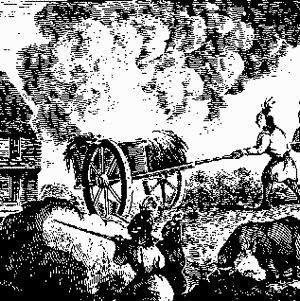
The attack was made early in the morning, and says Mrs. Rowlandson, “quickly it was the dolefullest day that ever mine eyes saw.” The house was defended upwards of two hours with determined bravery. The Indians, “after several unsuccessful attempts to set fire to the building, filled a cart with combustible materials, and approached the defenseless rear. In this manner the house was soon enveloped in flames. According to Mrs. Rowlandson’s recollection of that “amazing time,: the Indians had been near the house about two hours before setting it on fire. The enemy from the barn, or behind the hills, or any shelter, watched every opportunity to shoot the defenders, if any one were exposed at window of loophote.
Pg. 106
“The bullets seemed to fly like hail.” soon one man was wounded, and then another, and then a third. The fire from combustibles in the cart seized on the house, when one brave man ventured out and quenched the flames. Would that his name was on record! But the fire was again lighted, and soon spread over the house. Some in the house were fighting for their lives, and some wallowing in their blood. The fire was over their heads, and the “bloody heathen ready to knock all who stirred out on the head.” Now might be heard mothers and children crying out for themselves and one another, “Lord, what shall we do?” Then, says Mrs. Rowlandson, in her touching narrative; “I took my children, (and one of my sisters hers,) to go forth and leave the house; but as soon as we came to the door, and appeared, the Indians shot so thick that the bullets rattled against the house, as if one had taken a handful of stones and thrown them, so that we were forced to give back.” Their six stout dogs, at other times brave, and ready to fly at an enemy, lost all spirit, and would not stir. The fire increasing behind them, they were forced out of doors, where the Indians were eagerly watching to shoot them. Immediately Thomas Rowlandson, (brother of the minister,) who had been shot in the neck while in the house, fell down dead, whereupon the enemy shouting fell upon him, and stripped him of his clothes. A bullet went through the side of Mrs. Rowlandson, and also through the hand and bowels of her little daughter, six years old, by her side. The son of a sister, Mrs. Kerley, wife of Henry Kerley, had his leg broken, when the Indians knocked him on the head. “Thus,” says her narrative, “were we butchered by those merciless heathens, standing amazed with the blood running down to our heels.” She goes on in these words; “My elder sister being yet in the house, and seeing those woeful sights, the infidels hauling mothers one way and children another, and some wallowing in their blood, and her eldest son telling
Pg. 107
Her that her son William was dead, and myself wounded, she said, ‘Lord, let me die with them;’ which was no sooner said, but she was struck with a bullet, and fell down dead over the threshold. Then the Indians laid hold of us, pulling me one way and the children another, and said, ‘come, go along with us.’” Of all in the house, whether thirty-seven or forty-two, only one, Ephraim Roper, escaped. Twelve were killed, some shot, some stabbed with spears, and some knocked on the head with hatchets. One was “chopped into the head with a hatchet and stripped naked, and yet was crawling up and down.” all of the dead were “stripped naked by a company of hell-hounds, roaring, ranting, singing and insulting as if they would have torn our very hearts out.”

All accounts speak of the great bravery of the defenders. One writer tells us that eight men sacrificed their lives in the effort to rescue Mrs. Rowlandson. The true statement is that ten or twelve men, with women and children, took refuge in the garrison with her family, and the men were victims, with one exception. The rest were either put to death on the spot, or were reserved for torture. Mrs. Harrington states that there were twelve men, and he gives the names of the eleven following, “ Ensign Divoll, Abraham Joslin, Daniel Gains, Thomas Rowlandson, William and Joseph Kerley, John McLoad, John Kettle and two sons of Josiah Divoll.” He adds an “&c.,” which completes the twelve. William Kerley was probably the brother of Capt. Henry Kerley. The wife of Ephraim Roper was killed in attempting to escape. Mrs. Drew, sister of Mrs. Rowlandson, was taken captive; also the wife of Abraham Joslin and other women and children to the number of about twenty.

The fight was over. How many of the savages were killed is not recorded, but it was supposed that many were slain or wounded. The remainder, who were numerous, immediately began to plunder the houses, strip the dead of their clothing, and remove every valuable with could be taken away.
Pg 108
They also drove off all the live stock that were at hand. Fearing the arrival of troops from Marlborough, they started before night for the summit of George hill. There the hours of darkness were spent by the Indians in savage revelry. The poor captives were kept awake, near the great boulder, by the singing and howling of the victors; and according to the intimation of the one writer, by the dying groans of some of the victims. Lurid lights rose from the burning timbers of numerous houses; and the flames where the husbands, and fathers, and brothers were enduring torture, gave a tenfold horror to the darkness.

The women and children were taken into captivity with the purpose of obtaining ransom….[about 11 months later some still living were released.]

Different accounts vary in regard to the whole number of the slain, and the captured. There were fifty persons at least, and one writer says fifty-five. Nearly one-half of them suffered death on the spot, or in the wilderness. When Mr. Rowlandson, Capt. Kerley and Mr. Drew, all brothers-in-law, who had been seeking aid from the general court, in Boston, returned, a scene of horror met their eyes. The anguish they felt cannot be described, yet the tradition is that the minister was sustained by a strong persuasion that his wife would be restored. But this was uncertain. One child was wounded; the whole three, with their mother were in captivity, and many of his friends as well as the friends of his two companions, were killed or taken. Their dwellings had been burned. The wife of one, though he knew it not,was buried in the ruins. The wives of the other tow were in the power of the savages, threading their way through the trackless forest in the midst of winter, with no comforts, and no friends to cheer them, either starving with hunger, or preserving life by eating the most loathsome offal, separated from each other, and with nothing but death or hopeless captivity in prospect….
Pg. 110-112
The survivors took shelter, with what they could gather, whether of goods, provisions, grain or stock, in the near two fortified houses or garrisons; one of them on the land of Lawrence Waters, not far from the house of Mr. Symmes, R, and the other at Thomas Sawyer’s, not far the rear of the house now occupied by J. A. Rice, E. In these circumstances, they sent a most moving petition to the governor and council, singed by the occupants of both garrisons. The names of those who were in the garrison on the east side of North river, were Jacob Farrar, John Houghton, sen., John Houghton, jr., John Whitcomb, Job Whitcomb, Jonathan Whitcomb, John Moore and Cyprian Stevens. The signers in Sawyer’s garrison were John Prescott, sen., Thomas Sawyer, sen., Thomas Sawyer, jr., Jonathan Prescott, Thomas Wilder, John Wilder, Nathaniel Wilder, John Rigby, John Roper, and widows Wheeler, Fairbanks and Roper. The absence of several names will be remarked, as White, James, Parker, Gates, Rugg, Kerley, Drew, Rowlandson, and others who were still a live. The probability is that many families who were “burned out of house and home,” left as soon as possible for the lower towns. The petition of those who remained implored the governor and council that a “guard of men with carts might be ordered to Lancaster, to remove them to a place of safety.” They go on to say; “Our state is very deplorable in our incapacity to subsist: as to remove away we cannot, the enemy has so encompassed us; other wise for want of help and cattle, being most of them carried away by the barbarous heathen; and to stay disenabled for want of food. The town’s people are generally gone, who felt the judgment but light, and had their cattle left them with their estates. But we, many of us here in this prison, have not bread to last us one month, and our other provisions spent and gone for the generality. We are sorrowful to leave this place. Our women’s cries does daily increase beyond expression; which does not only fill our ears, but our hearts full of grief.” The above was drawn up by those in garrison on the east side of North river. Those on the other side add touchingly, “We are in like distress, and so humbly desire your like pity and fatherly care, having widows and many fatherless children.” According to Mr. Willard, “more than a hundred and seventy births are recorded: before the year 1676, and many of these were young at the time of the massacre. The parents of others had died in their beds, so that the fatherless, as well as the widows, were numerous in proportion to the whole population.

The place being considered untenable, troops were went up with carts, who transported the people, with their remaining movable property, to the eastern towns, where they found homes with their friends. Then the Indians, who seemed to have been lurking around, came out of their lairs, and set fire to the buildings still standing: and with the exception of the house of God and one dwelling, when they ceased to burn, there was nothing left but smoking and blackened ruins in this lovely valley. The settlers in the outskirts of the town, as well as in the center, withdrew under the protection of the soldiers. The settlement was abandoned. The The town was destroyed. For a year or two it was without a white inhabitant. Thus closes the second act in this awful drama; this carnival of arson and murder….


(History of the town of Lancaster, Massachusetts: from the first settlement ... By Abijah Perkins Marvin
Thomas Sawyer
.)

Wednesday, May 12, 2010

Success and Tragedy - Ancestory of Mary BRONSON

Relationship - GUNN:
11th great-grandfather
Dr. Jasper GUNN Immigrant (1606-1671) wife Mary/Christian -son- Nathaniel GUNN (1637-1663) died at age 24 wife 10th great-grandmother Sarah DAY GUNN KELLOGG (abt 1640-1677) -son- Samuel GUNN (1662-1755) wife Elizabeth WYATT (1665-1735) -daughter- Elizabeth GUNN (1689-1744) husband Simon COOLEY (1687-1747) -son- Lieut. Abner COOLEY (1712-1788) wife Jerusha GRAVES (1717-1801) -daughter- Jerusha COOLEY (1738-1803) husband David BRONSON (1733-1803) -son- Sylvanus BRONSON (1769-1830) wife Esther REMINGTON (1772-1835) -daughter- Mary BRONSON (1806-1888) husband Horace Datus ENSIGN (1797-1846) -son- Martin Luther ENSIGN (1831- 1911) wife Mary DUNN (1833-1920) -daughter- Harriett Camilla ENSIGN (1859-1930) husband Isaac SMITH (1857-1914) -son- George Ensign SMITH (1898-1967) wife Amy Ella HAWKES (1897-1971) -daughter- Camilla SMITH (1926-1999) - Lark - JR.

Success
First Doctor Jasper GUNN Immigrant (1606-1671)


Parent:
(Following the Ark of the Covenant: The Treasure of God, By Kerry Ross Boren, Lisa Lee Boren)
Page 171
Henry GUNN, …a direct descendant of Sir James GUNN (the Westford Knight). Removed from the Highlands of Scotland to Great Burstead in England shortly after the year 1600. A family record states that Henry Gunn’s wife, Sarah, was delivered of a son “ in the Highlands of Scotland” only days before their arrival at Great Burstead. That son, Jasper Gunn, was christened at Great Burstead on 9 August 1606 [LDS Gen. Soc. AFN: 8TH 3-F6.]

Jasper Gunn had little opportunity to know his father. Henry Gunn, who was a renowned sailor, with considerable knowledge of the coastline of America, either from the benefit of personal experience or from maps and charts of his ancestors, or both, had come to England to join the Hudson Expedition. As such, he would have necessarily worked closely with John Dee, who already had copies of the maps of the Sinclair-Zeno Expedition, and backed…
Page 172
Following the death of Henry Gunn in 1610-11, Jasper Gunn became a ward of none other than William Sinclair of Rosslyn, a very significant fact indeed,...
no more of page 172 available

Emigration:
(Families of Early Milford, Connecticut, By Susan Emma Woodruff Abbott, pp.316-317)
Jasper arrived in Boston, Mass. 8 October 1635 in the ship “Defense” that sailed from London 14 July 1535 when he was 29 years old. On the same passenger list was Ann Gunn ae 25, relationship, if any not known…. He settled in Roxbury, Mass. And on 25 May 1636 was made a “freeman” of that place at a General Court held in Boston. [He was allotted land in Roxbury in 1639 and was a member of the church there. The same year he was given land in Milford, Conn. As a free planter.]

Family:
(Families of Early Milford, Connecticut, By Susan Emma Woodruff Abbott, pp.316-317)
Jasper Gunn was born ca 1606 and died 12 January 1670/1 (MVR). He married [Mary] Christian (____) who died probably Octorber of 1690 in Milford.

Children: Samuel, Jobamah, Daniel, Nathaniel, Mehitable.

Founder:
Looking to start his own small colony, Jasper with several other families from Roxbury and Dorchester purchased even more land from the local Indians. Then on November 24, 1640 this area was named the town of Milford. Being considered one of the founders of Milford, Jasper Gunn was also considered to be Milford first physician. (http://www.ctparanormalhistorylegends.com/id12.html)

Religion:
(Families of Early Milford, Connecticut By Susan Emma Woodruff Abbott, pp.316-317)
Jasper and Mary were admitted to the church in Milford 25 april 1641 “having been admitted and dismissed from the church in Hartford”. The town of Milford gave him land on several occasions, 1639, 1646, 1649, 1659, 1660 and possibly at other times.

Physician:
Jasper GUNN first Doctor of Milford, CT. At Hartford Jasper GUNN recorded as being one of only two Doctors in the Colony.

(Thirty-one ‘phisitions’ were on hand for Connecticut’s Medical Beginnings, By Lawrence D. Nizza, reprinted with permission from The Hartford Courant (The Courant Magazine, June 2, 1957))
THE EARLIER physicians were men of several professions. Some were both tailor-surgeon, schoolmaster-doctor. These duties were not far removed from each other. In 1649, Jasper Gunn became a licensed physician. In addition to treating sick and broken bodies, he also repaired broken pots and pans. His accounts included bills for repairing kettles and skillets as well as for attending the sick.

(THE EARLY NEW ENGLAND DOCTOR: AN ADAPTATION TO A PROVINCIAL ENVIRONMENT* MALCOLM SYDNEY BEINFIELD, YALE JOURNAL OF BIOLOGY AND MEDICINE)
Page282
In the account book of Dr. Jasper Gunn of Milford, there were several copies of the actual bills rendered. It is interesting to note that Dr. Gunn made little distinction on his bills between medical services and the sale or repair of metalware, also that he charged more for the actual medicine administered than for his time and trouble. His account book reads:'

February 11, 1656
Due to me from Isake Ganis
Due before for his children ............. 7-6
for things for his young child.......... 5-0
for seven doses of pills .................... 7-0
for 4 journeys ................................... 2-0

March 4, 1656
Due to me from William Ayres s d
for 36 oz. of Sirups for John…..... 12-0
for 5 visits ........................................05-0
for 1 oz. oyntment.......................... 01-0
for two new ecillets ...........…........ 07-0
1 Bills are inscribed on the front leaves of an almanac formerly belonging to Jasper Gunn and now located in the library of Trinity College, Hartford. Published in G. Russell: Early Medicine and Medical Men in Connecticut, p. 13.

Other Occupations:
Milford:
(Families of Early Milford, Connecticut, By Susan Emma Woodruff Abbott, pp.316-317)
Gunn was Milford’s first physician, a mender of brass and copper vessels…, schoolmaster, sealer of weights and measures, a deacon of the church and generally a man of importance in the community.

Hartford:
(Families of Early Milford, Connecticut, By Susan Emma Woodruff Abbott,
pp.316-317)
In 1647, he removed to Hartford, Hartford Co, CT, where he continued his medical and other practices, also operating a mill, being exempted from "watching and warding" while so employed. He remained there until about 1659, and kept an account book during the 1650s, in which he also wrote medical notes, mostly in shorthand. The original can be found in the Watkinson Library at Trinity College in Hartford. In May 1661 he appeared in court in New Haven as attorney for Mrs. Joanna Prudden of Milford in a case involving the ownership of a horse. The horse was awarded to the plantiff John Davinport. The General Court licensed him 21 May 1657 to practice "physisicke."

(History of the colony of New Haven: before and after the union with …)
Page 94
General Court Nov. 24th, 1640
…At this meeting “it was also voted, so that justice be done between man and man, (because false weighs and false measures are an abomination in the sight of the Lord,) that all measures for commerce, for buying and selling, should be made equal to the standard used at New Haven, which was brought from the Bay, and to be sealed by Jasper Gunn: and that whosever should buy or sell by a measure not legally sealed, should forfeit for every such default. 5s.”
Page 112
The subject of education received early attention from the first settlers of the town. Good schools were considered of the highest importance to the community of anything next the church. The first school was kept by Jasper Gunn, the physician.
Page 136
Others of the first settlers were liberally educated. Of these were William Fowler,…Jasper Gunn,…Robert Treat. [Treat was our uncle, he became a Colonial Governor of CT.]


TragedySarah DAY GUNN KELLOGG (abt 1640-1677) Killed by Indians
During the Last Attack on Hatfield, MA on 19 Sep 1677

Sarah DAY GUNN KELLOGG (abt 1640-1677) was the daughter of Robert DAY Immigrant (abt 1604-1648) founder of Hartford, CT and his second wife Editha Stebbins (1613-1688). Sarah married Nathaniel GUNN 7 Nov 1658, Nathaniel was the oldest child of Dr. Jasper GUNN and Christian.

"There is a record of the births of their
[Nathaniel GUNN and Sarah DAY] first two sons , but they are not heard of again. Nathaniel Gunn was about 23 years old when he died, and his young wife was left with a son, Samuel [GUNN], born shortly before or shortly after his [father's] death. At the time, [Sarah's] mother [Editha] lived in Springfield, MA with her third husband [Rev. Elizier HOLYOKE], and Sarah Day Gunn joined her there.... On 24 NOV 1664, Sarah married Samuel Kellogg. They lived in Hatfield, MA."

(From "A History of Hatfield Massachusetts" by Daniel White Wells)
"Through Middle Lane poured a band of armed and painted warriors who fell upon houses lying outside the stockade. The torch was applied to the buildings of Samuel Kellogg at the corner of the lane, and his wife Sarah and her infant son [Joseph] were killed, and another child, Samuel [Kellogg], a boy of three years was seized and bound."

"It appears Samuel Kellogg, the kidnapped 3 year old half-brother to Samuel Gunn, was rescued in May 1678 by Benjamin Waite, et al."

(http://freepages.genealogy.rootsweb.ancestry.com/~dfgraves/Trees/Graves/TGraves.htm)
At about 11 o'clock on the morning of 19 Sep 1677, while most of the men were at work in the meadows cutting corn, Hatfield was attacked by indians. They came through Middle Lane and fell upon houses lying outside the stockade. They torched the buildings of Samuel Kellogg at the corner of the lane and his wife, Sarah, and her infant son were killed and another child, Samuel, 3 yrs., was seized and bound. Surprised by the suddenness of the attack, Obadiah Dickinson and one child were captured unresisting at the house below. His wife was wounded and left for dead and the house set on fire. John Allis's barn was burned and his six-year-old daughter, Abigail, captured. With no attempt to enter the open gate of the stockade the invaders rushed across the street to the houses on the east side, whose occupants were seeking places of safety. The indians sped northward and killed the wife of Selectman Samuel Belden, who lived on the Silas Porter place. John Coleman's house was burned and his wife, Hannah, and infant child, Bethiah, were slain, one child wounded and two were captured, of whom little Sarah was only 4. John Wells' daughter, Elizabeth, age 2, was killed, his wife, Sarah, and one child wounded. Hannah Jennings, wife of Stephen Jennings, was made prisoner with her two children by her former husband, Samuel Gillett, who was killed at an earlier fight. Philip Russell's wife, Elizabeth and their 3-year-old son, Stephen, were killed. Across the street, on the J.D. Brown place, stood the home of Samuel Foote, who had moved from his first allotment. His wife, Mary, with a young son, Nathaniel, and a 3-year-old daughter, Mary, were seized and dragged along. On the next lot above men were at work building a house for John Graves, Jr., who was soon to marry Sarah White. Hastening northward to finish their work of destruction, with an attack on the family of their hated foe, Benjamin Waite, they shot from the frame of the structure being erected the brothers, John and Isaac Graves, and 2 young carpenters from Springfield, John Atchisson and John Cooper. Waite's house was at the very end of the village street. The indians burned his house and barn and took away his whole family,--wife, Martha, and three children, Mary, Martha, and Sarah, aged 6, 4 and 2. Abigail, 8-year-old daughter of Wiliam Bartholomew, a former resident of Deerfield, was also captured.

[Also our 10th great grandfather Lt./Sgt. Isaac GRAVES a carpenter along with his brother John Graves the second husband of our 10th great grandmother Mary BRONSON WYATT were both killed in this Indian attack on the Hatfield settlement while building a house for John's son John, outside the walls of the stockade built to protect the town of Hatfield.]

(Redemptions of the Hatfield Captives - 1677-78)
On September 16, 1677, attacking Amerindians left Hatfield in chaos! Seventeen hostages were taken, 7 houses and barns burned, 12 villagers killed, and 4 wounded….

One man, Benjamin Waite, a scout who knew how to survive in the woods, knew what he was going to do. After all, his wife and 3 young daughters were among the hostages. The first move was to get to Albany as quickly as possible to find out if the Mohawks were involved. By October 4, Waite was back in Springfield reporting that the New York tribe was not involved. He immediately left for Boston before Benoni Stebbins, who had escaped from the Amerindians, arrived in Hadley with his news about the captives. Finally, after bureaucratic delays in Boston, Waite managed to obtain an appointment as agent to secure the release of the captives and funds were set aside to meet the ransom demands. A parley with the Amerindians in mid-October failed. The only recourse left for the English was to track the hostages to Canada, through territory never traversed by the English colonists.

By October 24, over a month after the raid, Waite and Stephen Jennings (whose wife and her two children were also captives) began the monumental task of finding the hostages. After petty bureaucratic delays in Albany, Waite and Jennings were finally given permission to go after the captives on December 10. Now the rescuers were faced not only with traveling through unknown territory but with deep winter snows. A local warrior guided them to Lake George, helped them fashion a canoe, and drew them a rough map of Lake George and Lake Champlain -- and then departed.
December 16, 1677 - Lake Champlain was reached, the first time English colonists had set foot there. Strong winds and ice slowed their progress, their provision ran out and they were forced to live off the land. But nothing could stop these two men for long. On or about January 6, the trackers reached the frontier of Canada, nearly 4 months after the raid on Hatfield. In a nearby town Hannah Jennings and a few other captives were found. The other hostages were close by with their captors. Immediately Waite and Jennings started for Quebec to bargain with Governor Frontenac for the release of the hostages. With the governor's help, the payment of two hundred pounds secured the release of the English. Of the 21 captives, 17 were returned; 2 children had been killed during the long trek north, probably because they fell ill. Sergeant Plympton of Deerfied was burned at the stake in Canada. Two children were born in Canada. Martha Waite had a daughter on January 22 who was named Canada. Nearly two months later, Hannah Jennings had a daughter who was named Captivity.
The English remained in Canada until the winter weather was over. At long last, on May 2, 1678, the entire party began the long, slow trip back home.
Relationship-GRAVES:
Thomas GRAVES Immigrant (1585-1662) wife Sarah WHITING (1581/1606-1666) -son- Lt./Sgt. Isaac GRAVES 1629 child immigrant (1620-1677) wife Mary CHURCH (1636-1695) -son- John GRAVES (1664-1746) wife Sarah BANKS (1668-1709/64) -son- Isaac GRAVES (1688-1781) wife Mary PARSONS (1688-1769) -daughter- Jerusha GRAVES (1717-1801) husband Lieut. Abner COOLEY (1712-1788) -daughter- Jerusha COOLEY (1738-1803) husband David BRONSON (1733-1803) -son- Sylvanus BRONSON (1769-1830) wife Esther REMINGTON (1772-1835) -daughter- Mary BRONSON (1806-1888) husband Horace Datus ENSIGN (1797-1846) -son- Martin Luther ENSIGN (1831- 1911) wife Mary DUNN (1833-1920) -daughter- Harriett Camilla ENSIGN (1859-1930) husband Isaac SMITH (1857-1914) -son- George Ensign SMITH (1898-1967) wife Amy Ella HAWKES (1897-1971) -daughter- Camilla SMITH (1926-1999) - Lark - JR.

Relationship 1 of 2
BRONSON:
12 GGF and 11 GGF Roger BRONSON (1576-1637) [Related twice through two children - John and Richard] wife Mary UNDERWOOD (1585-1622) -son- 11 GGF John BRONSON Immigrant (1602-1680) [In 1635, John accompanied his brother Richard and sister Mary aboard the ship Defense, landing in Boston, Massachusetts, on 8 October 1635.] wife Frances HILLS (-1680) -daughter- Mary BRONSON (1624-aft 1681) husband 1.John WYATT, (2.John GRAVES, 3.Lt. William ALLICE, 4.Samuel GAYLORD) -daughter- Elizabeth WYATT (1665-1737) husband Samuel GUNN (1662-1755) -daughter- Elizabeth GUNN (1689-1744) husband Simon COOLEY (1687-1747) -son- Lieut. Abner COOLEY (1712-1788) wife Jerusha GRAVES (1717-1801) -daughter- Jerusha COOLEY (1738-1803) husband David BRONSON (1733-1803) -son- Sylvanus BRONSON (1769-1830) wife Esther REMINGTON (1772-1835) -daughter- Mary BRONSON (1806-1888) husband Horace Datus ENSIGN (1797-1846) -son- Martin Luther ENSIGN (1831- 1911) wife Mary DUNN (1833-1920) -daughter- Harriett Camilla ENSIGN (1859-1930) husband Isaac SMITH (1857-1914) -son- George Ensign SMITH (1898-1967) wife Amy Ella HAWKES (1897-1971) -daughter- Camilla SMITH (1926-1999) - Lark - JR.

Relationship 2 of 2 BRONSON - this line is not involved in this story:
12 GGF and 11 GGF Roger BRONSON (1576-1637) [Related twice through two children - John and Richard] wife Mary UNDERWOOD (1585-1622) -son- 10 GGF Richard BRONSON Immigrant (1615-1687) [In 1635, Richard accompanied his brother John and sister Mary aboard the ship Defense, landing in Boston, Massachusetts, on 8 October 1635.] wife Abigail WILBOUR -son- John BRONSON (1645-) wife Hannah SCOTT (1651-1725) -son- Isaac BRONSON (1672-) divorced wife Thankful DIBBLE (1585-1622) -son- Joseph BRONSON (1708-) wife Mary TALYLOR (1708-) -son- David BRONSON (1733-1803) wife Jerusha COOLEY (1738-1803) -son- Sylvanus BRONSON (1769-1830) wife Esther REMINGTON (1772-1835) -daughter- Mary BRONSON (1806-1888) husband Horace Datus ENSIGN (1797-1846) -son- Martin Luther ENSIGN (1831- 1911) wife Mary DUNN (1833-1920) -daughter- Harriett Camilla ENSIGN (1859-1930) husband Isaac SMITH (1857-1914) -son- George Ensign SMITH (1898-1967) wife Amy Ella HAWKES (1897-1971) -daughter- Camilla SMITH (1926-1999) - Lark - JR.


Thursday, February 19, 2009

Captive / Wounded / Slain by Indians

11th great grandparent (JR; Lark; Camilla SMITH; George Ensign SMITH; Harriett Camilla ENSIGN; Martin Luther ENSIGN; Mary BRONSON; Sylvanus BRONSON; David BRONSON; Mary TAYLOR; Hannah GILLETT; Hannah DICKINSON; Frances FOOTE; Nathaniel FOOTE and wife Elizabeth DEMING.

[original spelling]

Pg. Xxvi (The Foote Family by Nathaniel Goodwin)
The following narratives of Indian atrocities relate particularly to the children and other descendants of [11th Great-grandfather] Nathaniel Foote, the settler, and those connected with them by marriage.

[Family of Nathaniel Foote the settler - chronological Indian atrocities:

Son in-law John Dickinson - killed at Falls Fight -1676.

Grand son in-law Samuel Gillett - killed at the Falls Fight -1676.


Granddaughter Hannah Dickinson Gillett Jennings - taken captive by Indians - 1677.


Grandson Samuel Foote’s - wife Mary Merrick and two of her children taken captive - 1677

Granddaughter Elizabeth Foote Berlding [Belden] and three children slain by the Indians, two children wounded, her husband Daniel Belding [Belden] taken captive with one son and one daughter - 1696.
Grandson in-law Daniel Belding [Belden] taken captive with second wife Hephzibah Hephzibah was Killed - 1703 or 1704.

Granddaughter Sarah Dickenson Lane Kellogg - she and husband and four children taken captive - 1704 - Sarah escaped, her 4 year old son killed.

Great grandson Samuel Foote killed by Indians - 1704 (had be taken captive with mother Mary Merrick Foote in 1677.)

Great granddaughter (born while mother was in captivity) Captivity Jennings’ husband Abijah Bartlett killed by Indians -1708.
Grandson in-law Stephen Jennings Killed by Indians - 1710.]

[10th Great-Grandmother] Frances Foote, daughter of [11th Great-Grandfather] Nathaniel Foote, the settler, was married to [10th Great-Grandfather] John Dickenson first of Wethersfield, (Conn.,) after wards of Hadley, (Mass,) in 1648, - by whom she had a family of children [John Dickenson was slain at the Falls Fight]. --[9th Great-Grandmother] Hannah Dickenson, the eldest of the children, was born at Wethersfield, December 6, 16 1648, and was married to [9th Great-Grandfather] Samuel Gillett, of Hatfield, September 23, 1668. Mr. Gillett was lost at the “Falls Fight,” (the great fight with the Indians at Turner‘s Falls, on the Connecticut River,) May 19, 1676. His widow, Mrs. Hannah Gillett, was afterwords married to Stephen Jennings, of Hatfield, May 15, 1677, and was captured by the Indians and carried to Canada, September 19, 1677. She returned in 1678. Hencer, a daughter born soon after her return, was, very appropriately named “Captivity.”

[Hannah's father John Dickenson and her first husband Samuel Gillett had been killed by Indians at the Fall's Fight, later her second husband Stephen Jennings would be killed by Indians.]
[Hannah had been remarried only a few months when on 19 Sept. 1677 she and her 5-year old daughter Mary and her 4-year old son Samuel were captured during an Indian attack on Hatfield. Hannah was pregnant at the time. When the authorities refused to pursue the Indians in fear of ambush, her husband and Benjamin Wait set out together to recover the captives who were headed for Canada. After a journey that lasted all winter they reached Canada in January and negotiated a ransom with the French. There Hannah had a daughter she named Captivity Jennings on 22 Jan. 1678. Hannah returned home with her children in June 1678.[36] On 22 July 1710 Stephen Jennings while engaged in making hay was ambushed and killed by Indians at Brookfield. Captivity Jennings married Abigah Bartlett. He too was killed by Indians Oct. 1708.(http://freepages.genealogy.rootsweb.ancestry.com/~bart/GILLET.htm)]

In or soon after the year 1690, Mr. Jennings removed with his family to Brookfield, (Mass.,) - a place which “has been famous for Indian inhabitants, Indian wars, and Indian barbarities,” - where on the 20th of July, 1710, he and five others, being at work in the meadow making hay, were sprung upon suddenly by the Indians, ++ and killed.

++ “The last mischief which was done by the Savages in Brookfield, was about the 20th of July, 1710. Six men, viz: Ebenezer Haward, John White, Stephen and Benjamin Jennings, John Grosvenor and Joseph Kellogg, were making hay in the meadows, when the Indians, who had been watching an opportunity to surprize them, sprung suddenly upon them, dispatched five of them, and took the other, (John White,) prisoner - White, spying [pg. xxvii] a small company of our people at some distance, jumped from the Indian that held him and ran to join his friends; but the Indian fired after him, and wonded him in the thigh, by which he fell; but soon recovering and running again. He was again fired at and received his death wound.” (History of Brookfield, by Rev. doct. Fiske, Pastor of the third church in that town.)

“The six men who in 1710, were killed in the meadows between this place and the south Parish, were buried in the Old Burying Ground, (which is situated about 80 rods southwest of the Meeting House.) The six graves are still discernable in the line next west of Mr. Cornelius White’s.” (Historical Discourse of Rev. Joseph I. Foote, Pastor of the first church of Brookfield, November 27, 1827.)

Pg. xxvii (The Foote Family by Nathaniel Goodwin)
His [Mr. Jennings] daughter “Captivity,” after she grew up to womanhood, became herself a captivator; inasmuch as she captivated Abijah Bartlett, of Brookfield, to whom she was married:- but, as if her fate was mysteriously linked with savage barbarity, he likewise was slain by the Indians, in October, 1708.

[9th Great-Grand Aunt] Sarah Dickenson, another of the daughters of John Dickenson was married to Samuel Lane, of Hatfield, (Mass.,) 1677. He died in Suffield, (Conn.) After his death she was again married to Martin Kellogg, then of Hatfield, afterwards of Deerfield, and subsequently of Suffield, by whom she had four children. She was his second wife. His first wife was Anna Hinsdale.

When Deerfield was destroyed by the French and Indians, February 29, 1704, Mr. Kellogg and four of his children, viz: Martin, born of his first wife, October 26, 1686, and Joseph, born November 8, 1691, Joanna, born February 8, 1693, and Rebecca, born December 2, 1695, all of his second wife, - were captured and taken to Canada. Mrs. Kellogg escaped. Epaphras Hoyt. Esq., in his Book entitled “Indian Wars,” gives the following history of this family: [Jonathan Kellogg age 4 was killed.]

“Among the captives was a family of Kelloggs, whose history is interesting. They were Martin, Joseph, Joanna and Rebecca. Rebecca, the youngest, resided at Cabnawaga, (N.Y.,) until a woman grown, and became extensively acquainted with the language of the Indians in that quarter. She and her two brothers, Martin and Joseph, who also learned the Indian language, were often employed as interpreters, the two latter at Indian treaties. Joseph attended one in that capacity, at Albany, in 1754; and accompanying Governor Shirley on the expedition against Oswego the nest year, did at Schenectady. Rebecca married a Mr. Benjamin Ashley, and was repeatedly employed as an interpreter by missionaries. In 1757, she accompanied the Rev. Gideon Hawley on a dangerous and tedious tour through the woods to Susquehannah river, on a mission to the Indians in that quarter, and [Pg. xxviii] died at one of their towns the same year. Martin was several times captured by the Indians, and conveyed to Canada, and afterwards bore a captain’s commission. He was remarkable for bodily strength, and firmness of mind; and many expolits of his early life, are related. Mr. Sargeant employed him in the Hollis School, where his knowledge of the Indian language rendered him eminently useful. He spent the last years of his life, at Newington, (Conn.,) and died about 1758.”

Pg. xxviii (The Foote Family by Nathaniel Goodwin) Martin Kellogg, son of Martin Kellogg aforesaid, settled in the first Society in Wethersfield, (Conn.,) and, for a season, dwelt on the lot next east of the Congregational meeting house, known as the Latimer place, where he was married to Dorathy Chester, daughter of Stephen Chester, son of John Chester, and of Sarah his wife, daughter of Governor Thomas Welles, all of the same town, January 13, 1716. Mr. Kellogg subsequently removed with his family to Newington Society, in the same town, where he continued to reside until his death, - which, according to a record on the stone at his grave, occurred on the “13th of November, 1753, in the 68th year of his age.”

Joanna Kellogg, the remaining captive child of Martin Kellogg, senior, through choice, remained among the Indians, and when she grew up, was married to an Indian chief. She died, leaving children. Before her death, she, together with several of her children, visited her half-brother, martin Kellogg, at Newington; but could not be induced to take up her residence with him. Her love of the “wild woods,” was too strong, and she returned to her Indian home. +

+ I have this account relating to Joanna Kellogg, from my friend Gen. Martin Kellogg, of Newington, great grandson of Capt. Maritn Kellogg, referred to in the account.

The difficulty of retaining in civilized society those who have been so long in captivity as to become accustomed to savage life, was often very great. A singular instance is found in page 240 of the Brookfield Record of lands. “December 9, 1714, Then granted to Margaret Otice, alias Lebue, one that was a prisoner in Canada, and lately came from thence, forty acres of upland in Brookfield, and twenty acres of meadow; provided she returns not again to live in Canada, but tarries in this province or territory, and marries to Capt. Thomas Baker.” The proposal was accepted. Capt. Baker was the first representative sent from this town to the General Court. Note to Rev. Dr. Fisk’s History of Brookfield.

[9th Great-Grand Aunt] Elizabeth Foote, daughter of Nathaniel Foote, of Wethersfield, (Conn.,) son of Nathaniel Foote, the settler, was married to Daniel Belden [Belding - 9th Great-Grand Uncle], of Hatfield, (Mass.,) Nov. 10 1670. They had fourteen children.

“Elizabeth, wife to Daniel Belden ye head of the family, together with Daniel Belden, John Belden and Thankful Belden, their children, were all of them slaine by the enemie, September 16, 1696.”
Pg. xxix (The Foote Family by Nathaniel Goodwin) “Sept. 16, 1696, The Indians came along from up Green-River to the town, and assaulted Mr. Daniel Belden’s house, - took Mr. Belden his son Nathaniel and daughter Esther captive, killed his wife and three children, and wounded Samuel and Abigail, but they recovered, - altho’ Samuel had a hatchet stuck in his head, and some of his brains came out at the wound.”
“The Indians making an Assault upon Deerfield, in this Present War, they struck a Hatchet some Inches into the Skull of a Boy there, - even so deep, that the Boy felt the force of the Wrench used by ‘em to get it out. There he lay a long while Weltering in his Blood; they found him, they Dress’d him; considerable Quantities of his Brain came out form time to time when they opened the Wound; yet the Lad recovered, and is now a Living Monument of the Power and Goodness of God.”

[Mother Elizabeth Foote Belding, granddaughter of Nathaniel Foote the Settler - 16 Sep 1696 Slain by the enemy [Indians].
Her children:

16 Sep 1696 Taken captive daughter 23yrs - Elizabeth -

16 Sep 1696 Taken captive daughter 12 yrs old - Esther -


16 Sep 1696 Severely Wounded 11 yrs old son Samuel - left for dead


16 Sep 1696 Wounded 6 yrs old daughter Abigail

16 Sep 1696 Slain by Indians son 15 yrs - Daniel


16 Sep 1696 Slain by Indians son 3yrs - John


16 Sep 1696 Slain by Indians daughter 8 months old - Thankful

Taken captive at a latter date - Father Daniel Belding - with his second wife Hephzibah - Hephzibah was killed.]


On the 17th day of February, 1699, Mr. Daniel Belden [Belding - 9th Great-Grand Uncle] afore-said was married to [spouse 2 of 9th Great-Grand Uncle] Hepzibah Welles, widow of Thomas Welles, Jun., of Hatfield. He died in 1691. In 1693, two of the children of Mrs. Welles were slain by the Indians, and her other daughter severely injured.

“June 6, 1693. The Widow Hepzibah Welles’ three daughters were knock’d in the head and scalp’d; two of them died, but the other lived.”

In the desolation which befell Deerfield, by an incursion of the French and Indians, February 29, 1703/4, Mrs. Welles herself, then Mrs. Belden, together with Rev. Mr. John Williams and his wife and children, and about one hundred and twenty of their neighbors, were by them taken captive and marched for Canada: but, horrible to relate, Mrs. Belden together with Mrs. Williams and several other women, were most cruelly put to death on the way.

“Hepzibah Belden was killed after they went out of town.”

“He that took me was unwilling to let me speak with any of the prisoners, as we march’d; but on the morning of the second day, he being appointed to guard the rear, I was put into the hands of my other master, who permitted me to speak to my wife when I overtook her, and to walk with her to help her in her journey. On the way we discoursed of the happiness of those who had a right to an house not made with hands, eternal in the heavens: and God for a father and friend; as also that it was our reasonable duty quietly to submit to the will of God, and to say, The will of the Lord be done. My wife told me, her strength of body began to fail, and that I must expect to part with her; saying, she hoped God would preserve my life and the life of some, if not all our children with us; and commended to me, under God, the care of them. She never spoke any discontented word as to what had befallen us, but with suitable expressions, justified God in what had befallen us. We soon made an halt, in which time my chief surviving master came up, upon which I was put upon marching with the foremost, and so made to take my last farewell of my dear wife, the desire of my eyes, and companion in many mercies and afflictions. Upon our separation from each other, we asked for each other, grace sufficient for what God should call
[Pg. xxx (The Foote Family by Nathaniel Goodwin) ] us to. * * * * * * I was made to wade over a small river, and so were all the English, the water above knee deep, the stream very swift; and after that to travel up a small mountain; my strength was almost spent before I came to the top of it. No sooner had I overcome the difficulty of that ascent, but I was permitted to sit down, and be unburdened of my pack. I sat pitying those who were behind, and intreated my master to let me go down and help my wife; but he reused, and would not let me stir from him. I asked each of the prisoners, (as they passed by me,) after her, - heard that passing through the above said river, she fell down and was plunged over head and ears in the water; after which she traveled not far, for at the foot of the mountain, the cruel and blood-thirsty Savage who took her slew her with his hatchet at one stroke, - the tidings of which were very awful: and yet such was the hard heartedness of the adversary, that my tears were reckoned to me as a reproach.” (Hatfield Town Records)


Pg.. xxx (The Foote Family by Nathaniel Goodwin)
[9th Great-Grand Uncle] Samuel Foote of Hatfield [son of Nathaniel Foote, of Wethersfield, (Conn.,) and grandson of Nathaniel Foote, the settler, and was born May 1 1649.] was married to Mary Merrick, of Springfield, in the same State, in 1671. They had eight children. The mother and two of the three first born children, viz: Nathaniel, born 1672; Mary, born July 9, 1674, and Samuel born about 1676, are referred to in the Record, of which the following is a copy,-

“Goodwife Foote and two children were carried away by the Indians, in ther irruption on Hatfield, September 19, 1677” (Hatfield Town Records)

They were all subsequently restored. And the following article has reference to Samuel Foote, one of the above children.

“Samuel Foote was slain at Deerfield, in the meadow, near the town, February 29, 1703 / 1704.” (Rev. John Williams‘ “Redeemed Captive.”)