Showing posts with label DAVIS Elizabeth Ann. Show all posts

Wednesday, June 28, 2017

Recollections of my Grandparents Charles Parker Sr. and Elizabeth Ann Davis By: Grandson Burns V. Parker

Recollections of my Grandparents Charles Parker Sr. and Elizabeth Ann Davis
By: Grandson Burns V. Parker
back- Zina Ett, John Davis, Sophia, Ray Cecil, Charles, Laura Elizabeth,
middle-Charles PARKER Sr., Bruce Fayette, Elizabeth Ann DAVIS PARKER,
front- Samantha Ahlena, Esther,

This was prepared at the request of our Aunt Sophia Parker Stapley to be included in her autobiographical history - "Together Again". It either reached her after the history went to press or some of the descriptive material was a little too strong. Regardless, it is being re-typed hopefully to give our younger relatives a sense of the wonderful people our Grandparents were.

Grandpa[Charles Parker Sr.] was born December 30, 1853 in Centerville, Davis County, Utah. Grandma [Elizabeth Ann Davis] was born January 8, 1859 at Old Fort Harmony, Utah. They were married March 10, 1880 in the St. George Temple, Washington County, Utah. He passed away May 15, 1935 in Kanarraville, Utah and she passed away February 26, 1927 also at Kanarraville, Utah. "Together Again" gives great detail which I will leave to you to re-read. It is CHOICE!

When this was first written in 1976 I jotted down some tid-bits of memory; little anecdotes and reflections as they came to mind. It brought back some very pleasant and poignant memories. Some of the detail may have been transferred from my parents and others, but as it is written it will sound as it came to me first hand. Recollections are presented as topics as follows:

1. THE BOX: Grandma had suffered with Arthritis for many years and had been non-ambulatory for over 30 years before her death. She occupied the center of attention in the middle of the living room in a chair with a wooden box three sided with a top always placed over her very tender feet. She was always so kind, cheerful and gentle. I sat on the box looking up at her while she told the most interesting stories. She always had a way of encouraging everyone who had troubles and adversities with her cheerfulness and it seemed to always pay off. I felt a great personal loss when she passed away. Grandpa was always very kind and gentle in taking care of Grandma.

2. THAT GLORIOUS PLACE---THE CELLAR: The cellar was a storehouse for the summer's labors and it held a great charm for me with the good smells and delicious tastes it contained. I remember the meats in brine; the rock salted pork; the stored smoked meats including hams, bacon, pork jowls and beef tongues; the pickles in bottles, brined and dilled in casks; bottled and canned fruits and vegetables; dried fruits and nuts; the apple bin with apples in straw or sawdust (what an aroma and taste!); coal for the stoves; cans of sorghum and honey; and GRAPE JUICE which was intentionally allowed to become wine; and ON AND ON. INDEED, WHAT A LOVELY PLACE TO SETTLE DOWN WITH FOR A LONG HARD WINTER.

3. THE PIG KILLING: This was always enjoyed and anticipated by all the youngsters and I think the grown-ups as well. If enough pigs were slaughtered all of the youngsters could have a bladder to blow up and use as a football. What Greasy Fun! The evenings were also Devine with fresh broiled kidneys over the coals in the fireplace of the old kitchen range. A treat to be sure! The mammoth table in the living room kitchen was equal to the task of holding several carcasses while being cut up. The heads furnished meat for head cheese, mince meat, brains, tongues, jowls--you name it. Everything was used except the squeal.

4. THRESHING TIME: Before feeding the threshing machine, the grain had to be cut and bundled by the combine harvester; placed in shocks in the field to prevent rain damage or immediately hauled by team and wagon to the grain stack. I had the distinct duty to tromp and arrange the bundles on the wagon to prevent from sliding off during the trip from the field to the stack. I was too young or too small to feed the thresher from the stack. It took two men to do so and about as many to off-carry the sacks of threshed grain, to the granary, on their shoulders. Getting the dinners ready for all the workers was also a formidable effort, but the great expanse of food, quantity, variety and flavors compensated everyone for the preparation. Both Grandparents seemed to enjoy threshing time as much as the rest of us and Grandpa would let the grandkids play in the grain in the bins. What fun! This privilege usually stopped when the threshers left, however. What s great time--THRESHING TIME!

5. FARMING AND LIVESTOCK RAISING: Grandpa realized the need of fertilizer for better crops and if he wasn't doing other chores you could see him loading manure with a manure fork into the low "truck wagon" then hauling the wagon by a team of horses to the fields or on garden plots in town before spreading it by hand. It was smelly, but produced good gardens and crops.

Hay hauling time gave me mixed emotions. I was normally the tromper and in a single summer tromped over 100 loads of hay. My siblings helped with the tromping sometimes though. I looked with envy to two of my favorite cousins (Gordon & Foch) who seldom had to work in the hay fields since both were victims of hay fever. I still remember how gentle Grandpa and my father were in pitching the hay on the wagon without covering me up. I could not say the same for Uncle Cecil. I doubted if he really cared if he covered me up or not and he was especially careless in pitching the thistle hay from the meadows behind the fields. Guess he had other things on his mind THE SPORTS OR THE NEXT HORSERACE. He has long since been forgiven though. Grandpa gave me a load of hay one summer for my efforts and I sold it for $8.00 which seemed like big money at the time, as I was only 10 or 12 years old. I helped weed the corn and ride a single horse pulling the cultivator in each furrow. It being manipulated by the one following it on foot. These were great and healthy times!

Grandpa was a great livestockman raising fine cattle, hogs and horses, but few sheep, however at one time he and my dad did own over 100 head of sheep. Grandpa was insulted by the name Jersey and prided himself in having some of the best Hereford and durham cattle in the area. I remember his prize Hereford Bull named Riverdale who besides being a great sire could also hold his own in a bull fight with any other bull in town. He also had developed a dairy strain of milch cows and he would be milking them before daylight while smoking his pipe unless he was shucking corn by lantern light, one of his pastimes. Grandma was no slouch when it came to raising silk worms and chickens. I don't remember the silk worms, but remember her saying that noise would cause the worms to spin knots in their filaments. Regarding her chickens she was very proud of her fine minarka hens. She was quite generous in giving me an egg or two to use as barter for candy at the Kanarra Coop Store.

Grandpa was a great horseman. You should have seen him ride one of his favorite mares "OLD RUTH"; a very lively animal and he handled her very expertly. He was a pretty accomplished veterinarian too. I have a vivid memory when he castrated "Old Chess", a Belgian bred station that had sired several colts. I was not much help at my age but was a very curious onlooker. Grandpa had a special way of trussing-up throwing and tying him up with a rope so he couldn't move. He did it alone. I was kind of a scrub nurse getting the materials together and heating up the searing iron. I watched with amazement the cutting, clamping, searing the chords, and rock salt treatment of the incision with NO STITCHES. The recovery of Old Chess was uneventful for a 3 or 4 year old station now a gilden. He was sold to Cox's in Hamilton Fort and was a good work horse for the rest of his life according to Jenny Cox, Mr. Cox's daughter.

6. GRANDPA THE GORMET: Grandpa's eating habits and style were always a delight to me, partly maybe because he was a "South Paw". He tried to introduce me to eating clabber (soured milk in pans or as it is now known as yogurt), but to this day I have no culinary interest in clabber or yogurt. He would pick up a desert spoon in his left hand--scoop up a spoonful from the clabbered milk pan then put about a teaspoon full of sugar then--SLURRP!-- and it was down except for what was caught on his mustache. He would cut thin slices of smoked ham and he would eat without further cooking--very delicious.

7. GRANDPAS SMOKE HOUSE: I was amazed at how well he operated his smoke house. He usually stoked the fire with wet corncobs soaked in a bucket to make the smoke. He saved them after shucking and shelling the corn from them. It took several days for bacons, hams, jowls, and beef tongues to reach their epitome of flavor--very delicious. They stored in the cellar since no refrigeration was available in those days.

8. FAMILY GET TO-GETHERS: I anticipated with pleasure the Summer Vacations and family get to-gethers with the locals and the out of town relatives. I enjoyed them very much when I was not committed to hay hauling, weeding and cultivating. Grandpa and Grandma were extremely good hosts for such occasions. The City Cousins got a chance to ride the horses; and even help in the hay hauling, cow milking and other farm chores. This made it easier for the residents. My recollections of get to-gethers with out of town relatives at Grandpa and Grandma's house took on three stages:

A. GREETINGS: Handshakes, hugs and kisses!

B. SOCIALIZING, FEASTING, FUEDING AND ARGUING: Socializing and Feasting are self explanatory. Feuding occurred with fights among the cousins and their parents in various combinations. Arguing usually involved politics. Lively discussions would occur. The more heated ones would be between Grandpa, Uncles Charlie, Cecil and Fay. Grandma & My father were usually the arbitrators, as I remember.

C. FAREWELL: Almost the repeat of "A"--with all the torments of "B" having been resolved. Finally the goodbye handshaking, hugging, kissing and this time TEARS. We locals always looked to next year's get to-gether again usually during the July 4th or 24th celebrations in Kanarraville.

Charles PARKER home Kanarraville, Utah, later owned by son John Davis PARKER

9. GRANDMA'S PASSING: As I recall there was a feeling of relief when Grandma was spared the agony of suffering and pain when she was taken. Grandpa became very lonely staying in the big house alone. He also began sampling some of Uncle Cecil's and Uncle Noel's labors with the barley, yeast, malt and water--Too Much I'm convinced as it did not enhance Grandpa as a bed partner when I would go down from our smaller house to stay with him at night. He seemed to appreciate my presence and the "Home Brew" smell is only a slight unpleasant memory.

10. PERIOD FROM GRANDMA'S PASSING TO GRANDPA'S DEATH: After Grandpa became reconciled to Grandma's death he seemed to get hold of himself and in my opinion lived a comparatively happy remaining life with his chance to live with his daughters in Salt Lake City and Castle Gate and spending the last few years in his home town, Kanarraville. I became quite concerned with my own growing-up and had less and less time to associate with him. A situation I now regret. I don't think I showed him the respect I should have after he returned to live the balance of his life with our family. He was in pain and agony, but stood up bravely before he died. He reached a period of peace and expired the same way. My father and I believe Van witnessed his passing and it truly was peaceful.

In conclusion, I as a grandson of Grandpa & Grandma Parker feel that the camaraderie and companionship I was privileged to experience in the brief time of 10 years with her and 18 years with him did enrich my life of which I am so grateful for. I look back with nostalgia, satisfaction and unfortunately with regret for not having grasped the opportunity during the fleeting time I was with them to have enjoyed their company more.

P.S. I hope that the foregoing will enrich your heritage & understanding of two of your ancestors.


Sincerely, Burns V. Parker

Wednesday, January 18, 2012

Kanarra Interviews - shared by Kerry Bate

LAURA ELIZABETH PARKER WOOD (1889-1970)
Notes collected by Kerry William Bate
Shared 15 Jan 2012
Pictured: back left: Zina Ett (1882-1962), John Davis (1891-1960), Sophia (1894-1986), Ray Cecil (1901-1994), Charles Jr. (1884-1960), Laura Elizabeth (1889-1970) - center left: Charles PARKER Sr. (1853-1935), Bruce Fayette PARKER (1903-1983), Elizabeth Ann DAVIS PARKER (1859-1927) - front left: Samantha Ahlena (1897-1981), Esther (1886-1975).

Interview by JoAnn Sylvester Bate with Reba Roundy LeFevre 22 September 1983 pp. 42-44: [Reba Roundy LeFevre (1904-2001) daughter of Joel Jesse ROUNDY (1864-1949) Sarah Catherine STAPLEY (1866-1949)]

(J) Right. Uh, also I have a question that isn't on here. We haven't talked about this, but she [Sarah Elizabeth ROUNDY SYLVESTER
(1893-1938)] had a friend called Laura Wood. Do you know her?
(R) Yes, I know Laura Wood. She--I forgot about her.
(J) She wasn't living in Hurricane
very long or very often. [Laura left Kanarra around 1910 before Sarah married and left Hurricane about 1933 some years before Sarah died there.] But every time she came around, mom Sylvester always had to go see her if she was in town.
(R) She was a [second] cousin. She was a cousin, and she was one that Sarah used to go around with.
(J) Now who was she before she was married then?
(R) A Parker?
(J) A Parker.
(R) Charles Parker's: daughter. Charles's: mother was [Almeda Sophia] Roundy [1829-1912], Charles Parker, and he married a [Elizabeth Ann] Davis [1859-1927]. And there was Charles Parker [Jr.], and [John Davis] ‘Dee’ Parker [(1891-1960)], Laura Parker [WOOD (1989-1970)], Esther Parker [ROBB (1986-1975)], and Sophie Parker [STAPLEY (1994-1986)], [Ray] Cecil Parker [(1901-1994)] and. And if there were any more than that I can't remember, it was so long ago.
Pictured: Esther Parker Robb, Charles Parker Jr., Laura Parker Wood
[More Parker siblings Zina Ett PARKER POLLOCK (1982-1962)], [Samantha Ahlena ‘Lena’ PARKER WILLIAMS (1897-1981)], [Bruce Faette PARKER (1903-1983)].
(J) And they were all cousins?
(R) They were all in one family.. They were all cousins of Roundy.
(J) All cousins of—right. Well, that's interesting, because remember Laura Parker's two kids.
(R) Yeah, she had one die— [one stillborn-unnamed .]
(J) She had several kids, [ five sons, two daughters.]
(R) (inaudible)
(J) But I only remember—she had a daughter that was always filing her fingernails that long. She was always making herself up. I don't remember her name. She was older than I was.
(R) I don't remember the names of the kids. She had one the other day that died, come in the paper. [Roland Parker WOOD (1913-1983)]

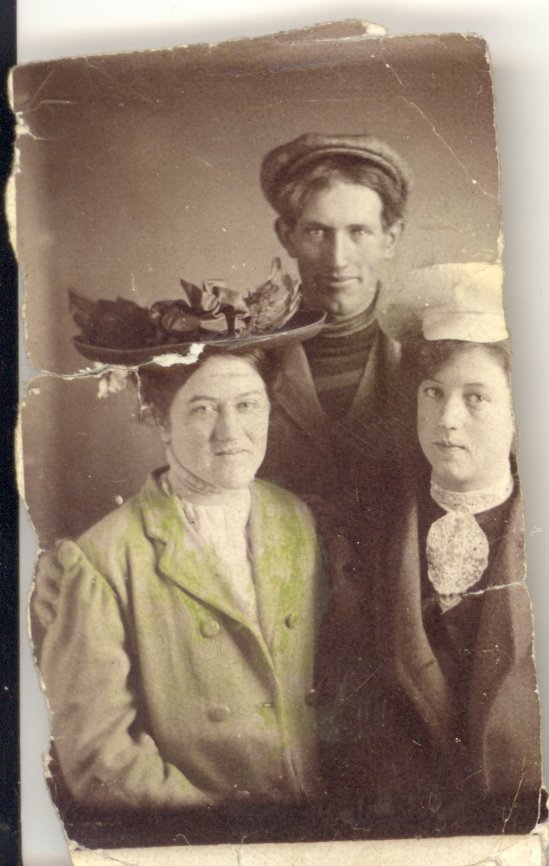
Pictured: Charles and Elizabeth Ann DAVIS PARKER

Interview by Kerry William Bate with Reba Roundy LeFevre [(1904-2001)] 21 July 1983, pp. 23-24: [Reba Roundy LeFevre (1904-2001) daughter of Joel Jesse ROUNDY (1864-1949) Sarah Catherine STAPLEY (1866-1949)]

(R) Yeh, Aunt Zina Pollock, Zina was a Parker. She's on [grand] dad's side [Joel Jesse ROUNDY (1864-1949)]. Zina was a Parker, and her mother [Elizabeth Ann] Davis [(1859-1927)] had--they called it rheumatic fever--and when most of her children--well, up until the time,-. I'll tell you a little bit about her background. When her parents [James George DAVIES / DAVIS (1831-1909) and Polly WILLIAMS (1838-1914)] moved to Kanarra they ran around all winter in their bare feet. They didn't have shoes, they didn't have stockings. And they ran all winter in their bare feet through snow about a foot, to a foot and a half deep, and nearly everyone of them had rheumatic fever. Well, she got rheumatic fever and she—about the last of her children that was born she kept getting' worse and worse and worse. Well when I knew her she set in a chair like that. It wasn't a rocking chair, though, it was just stationary. We used to go there once in a while when we was with Rhea. She had a stick about this long and when she wanted to scratch her nose she scratched with it this way, or if she wanted to rub her face she'd rub it this way. And she was almost set this way. [Elizabeth Ann DAVIS PARKER was for 20 years cripple by rheumatism and arthritis.]
(T) So she couldn't move her hands very much.

Pictured: Sophia PARKER
(R) No, she couldn't move her hands. She couldn't move her legs. And when Sophie, her daughter, [second] youngest daughter, took care of her—and she had a feather bed and she'd toss it this way and that way. Annis said, "do you expect somebody to sleep in that?" And she said "be quiet. That's the kind of way she likes it." So the menfolks picked her up and put her in bed like that. All the bumps come up in her legs and hit her back. And then when morning come why they got her out and put her in the chair and then she made the bed. She done the cooking and she done the washing and she done everything. The rest was all married.
Pictured: front left-Sophia PARKER, Luella WILLIAMS, Florence WILLIAMS, May WILLIAMS.
(T) Who was that who did the washing?
(R) Sophie Parker, her daughter. And Sophie Parker is the one that married [in 1920] William [Berry] Stapley [(1889-1959)]. And Zina was one of the girls and she was, oh, she was a real nice lady. She had--what--Emia?

[Emiah
Venita EVANS PARKER (1888-1974) wife of Charles PARKER Jr.]--no, not Emia--she had Zina and Sophie, Laura, and I believe there was one other daughter [‘Lena’]. Then she had four sons. When they were all married but Sophie and the two youngest sons, then she died. Can't remember what her name was [Elizabeth Ann DAVIES PARKER [1859-1927], but anyhow she died. And Sophie got so tired of taking care of her mother--she couldn't go here or there--she got so tired of taking care of her mother she didn't care whether she hurt her or when she put her in bed or anything. "Oh well," she said, "I try this and I try that and that don't suit you either!" But anyhow, when her mother died, her and Bill went to Castle Gate to work in the mines and they had that explosion. Bill's brother, Leland, died in the explosion but Bill didn't. And they stayed there, and then Bill got sick and he quit. Worked around and done other little things and then he got sick and died. And then Sophie went to California to live with her girls. She's still down there.
Zina had married Wally Pollock--his name was [William] Wallace Pollock-- they nicknamed him Wally. She had--Rhea was the oldest one, she was born in December and we was born in February, only she was born in 1903 and we was born in 1904. And we run with her quite a little bit, we liked her. She was jolly and everything but her mother said she didn't worry about her as long as she was with us, but when she was with somebody else she worried about her.
(T) What did your mother think about Zina?
(R) Oh, Zina was all right. Zina was all right, only she couldn't have control over Rhea. Sometimes she'd do crazy things. She'd go to grandma's and say, "I want some cinnamon and sugar," and she'd go get it and put it in a hand or in a sack or anything and go lickin' cinnamon and sugar. And that was all right as long as she was with us. But then when we moved away, why she got in touch with Ray Williams and had a baby.
(T) Oh. And that was Zina's daughter?
(R) Rhea was. And she had a baby and then she went to--Wally and Zina went up to Castle Gate to work in the mines up there but I think Wally [William Wallace POLLOCK (1875-1924)] got killed and Rhea's husband got killed. [Harry Winfield SANDERS (1903-1924), his father and brother were also killed.] She married another man, and Rhea's husband got killed. And then she went to California. And then Zina's boy went to California. So, they asked her to be the president of the primary, she said "Uncle Dode, you know I can't be a president of the primary?" He said, nr thought you just said you wanted a pair of twins!" "I do!" And he says, 'All right, you be president of the primary and you'll have your twins." And she said, "now uncle Dode, you don't mean that," and he says, 'I do."' And she had her twins.
(T) My heavens! That's something!
[?Who was asked to serve in the Primary, who is Uncle Dode and who had twins?]


Kanarra Drama photos published in "The Family of Joseph Henry Pollock and Alice Mae Davis," V. Ellis

Interview by Kerry William Bate with Rulon Berry Platt 2 August 1985, pp. 1-5, 11: [Rulon Berry Platt (1897-1988) son of John William Platt and Mary Wilhelmina Berry.]
Ah, I went over with your sister's and had a chance to read the history of your father and mother, and one of the things that told about your father, he was the leader in the dramatics, in the plays they put on down there. (R: Right. Right.) I wonder if you could tell me, to the best of your knowledge, when did that start down there in Kanarra?
(R) Oh, it'd be, [pause] umm, oh, it would be around the 1900s. You can't put a date on it. But around the 1900s. (K: Uh huh.) 'Cause I was born in 1897 (K: Uh huh.), and they were having dramatics when I was just a boy (K: Uh huh.), so you see if I--if it was in 1903 I would be six years old. (K: Uh huh.) So it was in the 1900s.
(K) Did they have it before that?
(R) Not very likely. They didn't have that church built.
(K) You never heard about them doin' things like that before that?
(R) I don't think they did, and if they did, they'd have to do on dirt floors. I don't think they did. I don't think so.
(K) What was your father's role in that?
(R) Oh, a director, instructor.
(K) Did he help select the plays?
(R) Oh, he always selected the plays. He always did that. (K) Who worked with him in that?
(R) Oh, he had a man by the name of William Stapley, did some with him. He had--do you mean the actors?
(K) The people that kind of were the leaders in the drama.
(R) Well, now that's it. Lynn Williams, Frances Pollock, ah, [pause] Susie Berry, ah, your grandmother (Sarah Elizabeth Roundy Sylvester] worked in it some. And, ah, Ethel Berry, Ethel Williams worked in it some. Ah, the menfolk were Alvin Williams, Jesse Williams, (K: Uh huh.), and, ah, occasionally there'd be one of the Berry brothers, Stapley--William Stapley, very often William Stapley. Every once in awhile they'd pick up one of the Davis boys if they happened to be around town, they'd get them to work in it. (K: Uh huh.)
(K) Who were the Berry brothers?
(R) Oh, that would be Jess Berry and William Berry.
(K) And who were the Davises that were in that?
(R) Oh, there was--umm--he used to use Wennie Davis, that was Aunt, ah,-- (K) Aunt Irona's boy?
(R) Yeah, Irona's boy. He's the oldest. (K: Uh huh.) And ah, ah, he did work, he did use Leon Davis, that was George Davises boy, (K: Uh huh.) some. He used the Parker boys some.
(K: Uh huh.) Dee Parker used to do some with him. Ah, the Parker girls Lynn--or not Lynn--Laura. And the one that married Jim Robb [James ROBB]--what the dickens was her name? [Esther PARKER ROBB ((1986-1975)] The oldest girl? [Esther third oldest child.]
(K) Married who?
(R) Jim Robb. (K: Oh.)
(K) Ah, did your father act in the plays or just the director?
(R) No, just directed.
(K) Do you remember any of the plays they did when you were a kid?
(R) Oh, title-wise it's been out of my mind.
(K) Do you remember any--what kinds of plays did they like?
(R) Oh, usually frontier plays. (K: Uh huh.) Oh, once in awhile they'd, they'd maybe get a play from, a city play or something like that. But right generally something the people were acquainted with.
(K) I see. And were they any--were they good plays?
(R) Always good plays. Always had good morals. (K: Uh huh.) Of course, they always had a villian. (K: Uh huh.) But, ah, those plays produced good morals. (K: Uh huh.) Clean, clean participatin'.
(K) I see. Where did they stage them at?
(R) Right in the old churchhouse.
(K) I see. Do--did Harmony and Kanarra ever do plays and then take 'em back and forth?
(R) I don't think so. Never heard of it.
(K) I see. Did you ever go over to New Harmony to see a play?
(R) Nope. Not me.
(K) Did New Harmony people ever come over to Kanarra?
(R) Oh yes. All the time. All the time. Whenever we had a theater in Kanarra they always came over, yeah. Some of 'em.
(K) I see. What kind of road was there between Kanarra and Harmony. (R) Just dirt road. Just old dirt road.
(K) Was it muddy or dusty or depend on the weather?
(R) Both. Both. If it was rainy it was mud. If it was dry it was dusty. (K) I see. What kind of scenery did they use in those plays?
(R) Always hand-made scenery. Painted on cloth. They'd take a, make their
own frames and cross-bar 'em, hang calico on it and paint on it. (K: Inaudible) Yeah, they made their own.
(K) What kind of scenery did they have?
(R) Oh, sometimes it was forests, sometimes people marching. It all depends, what the play demanded.
(K) Did it ever have cities or something like that?
(R) Never ever city life. They did have one or two plays of the Civil War. (K: Uh huh.) It was very fine. Very fine.
(K) I see. So they painted calico and hung it. Where at in the church did they have it?
(R) Well, they had a special built stage in the basement on the lower floor. (K) And that's where they danced, too.
(R) Yes, and that's where the music--they'd sit up on the stage and fiddle and diddle and they always danced down in the --.
(K) I see. So the musicians were up on the stage, (R: Right.) and the plays were up on the stage (R: Right.). Did they have a curtain?
(K) Did they have a curtain?
(R) Oh, you bet, long curtain, yes.
(K) And then how did they hang the calico in--on the stage? For the
backdrop. Was it just tacked to the wall or hung from the ceiling?
(R) No, a, they had strips of calico hung on the ceiling, hung down two or three feet wide, several strips, maybe three or four were hanging from
the ceiling. They were usually white. But to change a scene. They always made a bracket along on both sides (K: Uh huh.) and on each side they'd have a slip slot, both in the top and on the floor, and they'd slip these scenes in the slip slots.
(K) So they were kind of like a big piece of cardboard or something, in the sense they were stationary.
(R) Well, they was always--they was always made with wood with this calico strips over.
(K) Oh. So like big frames.
(R) Right. Right.
(K) Who usually painted the scenery? (R) The people locally.
(K) Was there anybody real good at that? (R) I guess all the girls. Usually.
(K) Do you remember any particular person. (R: No.) Did my grandmother paint scenery?
(R) No, she came along after that was kind of washing out. But your grandmother did take part in some of the plays. (K: Uh huh.)
(K) What kinds of parts?
(R) Oh, little girl parts, young lady parts and things like that. It was her age, of her age.
(K) Was she any good?
(R) Oh yes. Very good. She learned that in her dramatics up at Murdock Academy in Beaver.
(K) I see.
(R) She took that up there.
(K) So she did that after she went to Murdock.
(R) Oh yes. Yah.
(K) Ah, what kind of costumes did they have?
(R) They'd make their own. Didn't matter. If a man had to have a villian costume he'd cock and old hat or an old cap or an old ragged coat, old shoes, or something like that, if they had to be well-dressed--queen-- they'd make their own clothes.
(K) So they made their own costumes.
(R) Oh, always made their own costumes.
(K) Did they have a place they kept them at the church or did just own their own.
(R) Usually just everybody owned their own.
(K) So your father didn't have a (R: No, no) costumes to draw on (R: No, no, no, no, no.) Did they use any other kinds of props, like furniture?
(R) Not as a rule.
(K) Did they just borrow it from home if they needed something like that?
(R) If there's something special they'd bring it from home.
(K) What did the church actually have in there for them to use? Just the painted scenes? And the stage?
(R) That's all. That's all.
(K) How many people were usually at a production?
(R) You mean to watch it?
(K) To watch it.
(R) Oh, they'd run anywhere from a hundred up to two. (K: Really?) Oh yes. Those people always patronized. Always.
(K) So you had real good turn-outs.
(R) When they, ah, first brought the moving picture, slide moving picture in there, why, they couldn't get them in the building, basement. Kids! All of our kids, they'd climb on top of one another. Sit in there quiet as mice and watch those still pictures on the screen.
p. 11 above:
(K) What about Laura Parker?
(R) She was always the sweetheart, one of the sweethearts.

Interview by Kerry William Bate with Lynn [(1908-1993)] and Ella Batty [(1903-1994)] Reeves 15 October 1987 pp. 38-39:
Q: Laura Parker.
L: Oh Laura, well, she was a school teacher, an’ I was only about in the fourth or fifth grade and she left, her and her husband. Her husband was an insurance salesman, and he was a penman. One of the best they was in this country.
Q: Uh huh. What was Laura like?
A: Well, she was a small, little small woman, but I don’t know too much about ‘er, because like I say, she left when I –
Q: She left early. Did know her brother—her sister Soph-i Stapley?
L: Well, yes, I knew Soph-i [to his wife Ella] you knew Soph-i.
L: Ella: I think they was all good people.

Pictured: Iva Orilla WILLIAMS WOOD and second cousin Laura Elizabeth PARKER WOOD
Interview by Kerry William Bate with Reba Roundy LeFevre 16 January 1988, pp. 2-3: [Reba Roundy LeFevre (1904-2001) daughter of Joel Jesse ROUNDY (1864-1949) Sarah Catherine STAPLEY (1866-1949)]
Q: I see. Then there was Laura Parker Wood and Andrew Wood, and according to Nell [Sylvester Wilson], Andrew Wood drove them [Sarah and Victor Sylvester] out to Pahranagut when they moved out there. What—can you tell me about Andrew Wood?
R: I think he come from down in this port [Washington County] of the country. I don’t know where he come from. But I know that they were married [Married 1910 sealed in the St. George Temple in 1911.] , an I don’t remember about them drivin them out to Pahranagut, either.
Q: What—what kinda guy was he?
Pictured: George Henry WOOD Jr. and first cousin John Andrew WOOD
[John Andrew WOOD (1883-1933) came from Grafton, Utah with is cousin George Henry WOOD Jr. through Kanara working as a cowboy, when he met Laura PARKER. George Henry also married a Kanarra girl Iva Orilla WILLIAMS.]
R: He was a good guy. He worked with the people an done what he could an tried to get along an they—a—the wherewiths to take care of his family. He wasn’t the rowdy—one of these rowdy ones that gits out, he was jest a common person. Ah—[pause] I never was acquainted with im too much. I jest—[pause]
Q: What was Laura like?
R: Well, she was one of these good faithful saints that—don’t know where she picked him up at, but any how she picked him up [chuckling], they picked each other up I guess.
Q: Was she more churchy than he was?
R: Yes.

[Thanks to a grandchild of Sarah Elizabeth ROUNDY (1888-1938) and Victor Leon SYLVESTER (1893-1962).]

Friday, December 23, 2011

PARKER-DAVIS Family Group


CORRECTIONS:
Wife Elizabeth Ann DAVIS (DAVIES) father was James George DAVIS (DAVIES) not John.
Child #4 Laura Elizabeth PARKER and John Andrew WOOD were married in St. George, UT not Kanarraville.

(
"Together Again" 1976, by Sophia PARKER STAPLEY [1894-1986], p107.)

Childhood Memories of Kanara

These written and shared memories should inspire us to write down our own life and times. I will type this up as time permits so check back again and again to see how the story unfolds. Elaine ROBB is a older first cousin to Kirt DeMar WOOD.
back left: Zina Ett (1882-1962), John Davis (1891-1960), Sophia (1894-1986), Ray Cecil (1901-1994), Charles Jr. (1884-1960), Laura Elizabeth (1889-1970), center left: Charles PARKER Sr. (1853-1935), Bruce Fayette PARKER (1903-1983), Elizabeth Ann DAVIS PARKER (1859-1927), front left: Samantha Ahlena (1897-1981), Esther (1886-1975). See: PARKER family photos

Written by Elaine ROBB SMITH
[1911-2007]
Published in "Together Again" 1976,
by Sophia PARKER STAPLEY
[1894-1986]
pages 193-205
Photos added here by Lark
p193
The PARKER-DAVIES SIBLINGS
10. A Niece's Memories - Elaine Robb Smith
Esther's [Esther PARKER ROBB 18586-1975] daughter, Elaine -- my niece -- wrote a beautiful memory piece about her experiences with many of us, and it is problably the best way I know of to bring our part of the book to a close. Here is what she had to say, in her own words:

Charles PARKER's Kanarra Home
with grandchildren Elaine and Parker ROBB
and son Bruce "Fay" PARKER about 1914

When I was a little girl I always loved to go to Kanarra. When I was a big girl I loved to go to Kanarra. Now that I'm getting to be an old lady I still love to go to Kanarra. It brings back so many memories and fun things to think about that it makes me wish that I could start all over and do it again.

Kanarra hasn't changed. That is why it is fun to go there. My grandparent's [Charles PARKER Sr. 1853-1935] home still stands there by the stream where I used to wade and get my feet wet on a hot summer day. Seeing that house makes me remember a lot of things that otherwise might have been forgotten.

[BIG KITCHEN]
First, I remember the big kitchen where my Grandma [Elizabeth Ann DAVIS PARKER 1859-1927] always sat very patiently, hour after hour, with the biggest table I've ever seen and the oldest wood range where all the many good meals were cooked; such an inconvenient way to cook as compared to our electric push-buttons of today. It meant my Grandpa getting up at daybreak, chopping wood, and starting a fire hot enough for the cooks to take over the job of baking bread, cakes, pies, roasting meat, heating water for hand washing and dirty clothes. I well remember seeing these large heavy boilers filled with water and having to be lifted, emptied into wash tubs, and refilled, all through the day to keep the hot water supply going on, wash day or bath day. We took our baths in little round metal tubs while hiding behind a curtain to get a little privacy.

Behind the old kitchen stove was a little nest of kittens and Uncle Fay's [Bruce Fayette PARKER 1903-1983] mama cat. He was very proud of his cat and he gave us to understand that we were not to play with the kittens or the mama cat would eat them up!

We all loved Uncle Fay and Cecil [Ray Cecil PARKER 1901-1994] . They were always so good to us. They were pals to all the kids, playing games, babysitting,

p194
while our mothers were busy at work. They always took very good care of us and even let us go riding on the horses. 'Old Button' and 'Bert' were our favorite horses. We also got to ride Aunt Zina's [Zina Ett PARKER POLLOCK 1982-1962] 'Old Yardley' and Uncle Dee's [John Davis PARKER 1982-1962] 'Stamps'. They were all so well behaved and loved by all of the children. We all enjoyed the horses.
Uncle Cecil and Uncle Fay
on horseback
about 1904

[LITTLE GIRL]
I remember one day when I was very lonely and my mother [Esther PARKER ROBB 1886-1975] was too busy to be bothered. I wanted to go to Hilda's to play with her, but mama wouldn't let me. So I kept whining and pestering her, saying 'I want a little girl to play with!' Finally Uncle Fay became tired of listening to my whining so he decided to do something about it. As I looked up the stairway, coming down was a funny looking kind of fat girl with blonde, golden, silky hair. I had never seen anyone who looked like her before and I didn't know what to think. The girl said to me, 'You wanted a little girl to play with so here I am'. I looked at her funny boyish shoes and I listened to her odd sounding voice -- at first I just couldn't figure her out. Then gradually it dawned on me that this little girl was only my Uncle Fay, dressed up to fool me. I became so mad at him for trying to trick me that I screamed and yelled, calling him bad names. He pretended to have his feelings hurt so much that it brought me to my senses and I told him that I'd never call him a bad name again. I decided from then on to call him 'Uncle Fay Dear', which I did -- even until the time we were both grown up. Incidentally, the golden silk hair he wore was a wig made from my mother's silk worm crop, several years before.

[SNAKE]
It was at my Grandpa's that I saw my first snake. I was about five or six. I was wading in the ditch and as I looked down, beside a big cottonwood tree at the edge of the stream, I saw what appeared to be a beautiful, shiny silk glove at the base of the tree. It did not move and as I was just putting my hand over it to pick it up something told me 'No'. I jumped back and instinctively I screamed 'SNAKE'!!! (I had never seen a snake before.)

I ran crying to my Grandpa who immediately took his shovel and went with me to see it. Sure enough it was still there, all curled up asleep. My Grandpa shoved the sharp shovel down upon it, cutting it into many pieces and carried it away to bury it. Before he buried all of it, he cut off the tail end and showed it to me. It had ten rattles. Since then, every time I have ever thought of this true story I have become panicky all over again.

[COWS]
Our annual summer visits to Grandma's and Grandpa's farm were something we always looked forward to. Grandpa used to let me ride on the back of the saddle and take me to the field when it was my turn. We used to ride down each morning to take the cows from the barn to the fields, then in the evening we would go and

Grandpa - Charles PARKER Sr.
p195
bring them home to be milked, where they then stayed in the barn overnight. When we grew to be a little older he let two of us go on the horses together without him along. Then we thought we were pretty smart 'cowboys'.

One time in the cold part of the year. I remember my Grandpa having to take this trip alone on horseback. When he returned home from his morning trip, he was so cold that his mustache had long white icicles hanging from it. He looked just like 'Jack Frost' in person.

Grandpa's present to the new-born babies in his family was a cow; that is, if the parents of the baby would give him the honor of naming rthe baby. I remember a few of my cousins who were the proud owners of their very own caws. He named 'Ruth [Lurena]' [POLLOCK REYNOLDS 1912-2011], 'Gerturde' [PARKER COSSLETT 1915-2000], 'Diana' [PARKER MILLER 1920-1995], and 'Dorothy' [WILLIAMS STUKI.1921-1999]. Some of the others I don't recall. I always thought my cousins were very lucky to have a pet calf to grow up with them. I never owned a calf or a cow. But we moved around so much [that] I wouldn't have had a place to have kept it anyway.

Others in the family to whom Grandpa gave cows were the newlyweds. That was always his wedding present to a son or daughter just married. Of course Mama had her cow, but as we were always on the move she had to let Grandpa keep it and take care of it for her. Mama would never part with her cow, although she could have sold it and used the money. She thought that someday she would be settled and have her own home where she could keep it.

One year I do remember, though, that she did take care of a cow herself. It was when I was in the third and fourth grade. We were living in Cedar City, with Fay and Cecil staying with us while they were attending their first year of college at B.A.C. It was a rather sever cold winter, with lots of snow and freezing weather. One day a big blizzard came up. It really made us worry, because Mama's poor old cow was standing out int he back yard with no shelter of any kind and we were just afraid she was going to freeze to death. The snow was coming down fast and the wind was blowing terribly. Fay or Cecil had not arrived home from school yet and Mama could not stand any longer to see her cow suffering in the cold. So she carried down our old canvas tent and set it up over the cow. It was a nasty job, her struggling with no help to set up this cumbersome tent in such a terrific snow storm and high wind. I was too little to give her any help. (In fact, she made me stay inside.) So I just looked out of the upstairs window and watch her. I shall never forget that day or how my mother looked, pitching a tent over her beloved cow. The cow survived through the night and we were all happy.

p196
We had a cow down on the Farm, E - I - E - I - O !
It gave milk without alarm, E - I - E - I - O !
One day it drank from a frozen stream
And it froze her tail like an iron beam,
And ever since then she's give ice cream, E - I - E - I - O !

"Grandma was confined to her wheel chair"
Elizabeth Ann DAVIS PARKER 1859-1927

[SEWING]
Grandma and I kept each other company many times. After lunch each day, everyone except the two of us would go off to their bedrooms and take a nap. But grandma sat in her chair wile I usually stood at the big table sewing on doll clothes. She could teach me quite a few things about sewing even though she was confined to her wheel chair. It was at one of these sewing sessions that I made the first dress for myself. I was only seven years old. I went to the Kanarra Co-op Store to buy my material. There was not much choice in yardage but I bought about one yard and a half of light grey printed percale, at 10 [cents] per yard, and proudly carried it home even though it wasn't my favorite color. I was all excited and could hardly wait to get home to start cutting it out. Grandma had dozed off into a cat-nap in her chair, but I went ahead, spreading it out on the big table and cut it out just as thought I were making a doll dress. It was a 'Butterfly' style just like all the doll dresses I made. (That is, a one piece, without sewed-in sleeves or any set waistline.) I had no pattern so just whacked away until I had it all cut and half sewn before Grandma woke up. It was sewn by hand with big running stitches, almost like basting. By the time everyone had returned from their naps, I had the dress all finished and ready to wear. It was lucky that I could even get it on, as I knew nothing about measurements -- I just cut it by 'guess'. I thought I had done a real good job. Grandma was always very proud of my sewing. Later on she let me use her old [treadle] sewing machine. One of the first times I tried it I ended up running the machine needle all the way through my finger, white thread and all! It took a major operation to get me detached from the sewing machine.


[EGGS]
Grandma gave the grandchildren the chore of gathering her eggs. We would search all over the farm looking for eggs. It was just like a big Easter Egg Hunt, as we found eggs in some of the most unusual places: in the barn, tucked down in the hay; in the stables; down in the manger; even out on the bare earth in the corral; around the bushes; and in other unusual places. Sometimes we nearly stepped on an egg before we saw it. Grandma warned us not to go into the chicken coop as most of the hens had deserted it. One day my brother [Parker ROBB 1912-1999] and I didn't mind Grandma's warning, and we went in anyway to see if we could find a few more eggs. As soon as we were in there for just a short time we both began to itch like fury. It was one of the worst itches I have ever experienced. We ran out like we had been stung by hornets,

p197
But the itch kept right on. So we ran to the house yelling to our mother. When she saw us she just about had a fit! We were both just swarming with little tiny black chicken mites and they were driving us both crazy. Mama would not allow us to enter the house. She hurriedly stripped us of our clothes, to the nude, and turned the hose on us full force to try and wash the insects off our bodies. It wasn’t much fun having that swift stream of ice cold water on the bare skin, and ending up with a soapy shampoo too. But we got what we deserved after not having listened to Grandma’s advice. From then on we stayed out of the chicken coop. Mama had to boil our clothes in lye water; I’m glad she didn’t have to boil us too.

I remember Grandma used to save eggs. Then when she had quite a few she sold them for money to buy things with. Many times she sent me to the Co-op Store with a half-dozen or dozen eggs to trade for something she needed. Or she would sell them to the store for money. One year she saved up her egg money until she had enough to buy yardage to make a new plaid gingham dress for each of her granddaughters. We all had a different color plaid, and each of us was so proud of our ’Egg Dress’ from Grandma.

[ICE CREAM]
Aunt Sophie [Sophia PARKER STAPLEY 1894-1986] used to let me ‘lick’ the cream skimmer after she had skimmed the cream from the big pans of milk. The cream rose to the top of the milk after sitting for awhile, and was thicker than whipped cream. I can’t remember anything tasting better jam the Bread-n-Sugar-n-Cream’ that all of us ate for treats. It was almost better than Aunt Effa’s [Effa Mariah MULLINER (adopted by WILLIAMS) PARKER 1885-1969] home-made Carmel ice cream. Every year when Grandpa went to the mountain he brought back a wagon load of ice and snow and then we would have a big family party. Aunt Effa made the ice cream. Everyone took turns turning the freezer handle. Some of the extra ice cream was frozen in gallon buckets. We always had plenty to go around for as many refills as we could hold. It was sometimes pretty late in the evening before the ice cream was ready to be opened, but the children waited so anxiously and patiently. When it was finally ready to dish out, some of the children were so tired that they fell fast asleep before they could finish eating their first dish. Others were already asleep before the freezer was even opened. But those who did stay awake sat up and stuffed themselves until they could hold no more, and were on the verge of being sick. I remember very well about some of my cousins eating so much that they really were sick, and maybe the next morning even had to miss school because they had a belly-ache.

[TREATS]
Before Aunt Effa and Uncle Dee had any children they spent all their time thinking us ways to spoil their nieces and nephews. One year they lived upstairs, over the kitchen. Any time any of the children went to see them they always got treats. It must

p198
Have been from them that the original ‘Trick or Treat’ term began, They used to say to us: ‘Open your mouth and close your eyes, and I’ll give you something to make you wise’. We always opened our mouths wide; then when we opened up our eyes again there was something good to eat in our mouths. Sometimes it might be raisins, dried fruit such as apples, apricots or maybe a prune, or whatever they had on hand. One day Aunt Effa led me to the top of the stairway and stood me right below the attic hole. She then told me to close my eyes and hold my hands, cupped, high over my head. Then I heard her with her ‘Hocus-Pocus’, saying weirdly ‘Old man, Old man! Come on out! I waited excitedly. Then she repeated: ‘Old man, Old man! Come on out! After another short wait I heard a rumbling, funny noise and then suddenly I could feel something dropping into my hands. When I opened up ;my eyes and looked into my hands, what a surprise! My hands were full of nuts and candy! Each time a child would visit them, the ‘Old man’ would drop treats into their hands -- but only while their eyes were closed. If any child ever dared to peek the ‘Old man’ was sure to disappear back up into the attic where he was supposed to live. It was a long time before the children were smart enough to realize that there was no ‘Santa Claus’ in the attic.
One day DeVere [William DeVere POLLOCK 1910-2004] came upstairs while Aunt Effa and Uncle Dee were away, He stood at the top of the steps, under the attic opening and closed his eyes holding his hands as he usually did, in a cup about his head, and used their call. He could not get any response. No candy came pouring into these hands. Nothing happ4ened, although he had used the same 'Hocus-Pocus' that Uncle Dee or Aunt Effa used. He continued to stand there calling 'Old man, Old Man', pleading, almost as though he were praying. Still nothing happened. After quite a while he became discouraged and gave up. He was so puzzled as the 'Old Man' had never disappointed him before. It was much later that DeVere and all of the other children became wise to the game of Uncle Dee and Aunt Effa continuing to play 'Santa Claus' all year round.

[MOUSE TRICK]
Aunt Effa was such a jokester, always clowning. If she wasn’t surprising somebody, she was trying to play tricks on them all the time. She sued to chase Uncle Dee all over the house and then out into the yard, telling him she had caught a mouse in a paper sack and that she was about to let it escape. Uncle Dee was frightened to death of mice, so he would run all over the lot with Aunt Effa hot on his trail But she could not catch up with him. She pulled this same trick on him several times before he finally found out that all she had was an egg rolling around in the sack.

[CHILD BIRTH]
Aunt Effa played a trick on me too. It was the middle of August. I was five years old. Mama and I went down to visit with Uncle Dee and Aunt Effa while they were living in their little…

p199
House down behind the meadow, beside Grandpa’s big barn. I was having a good time playing with the toads and enjoying myself, as my brother had stayed in town with Grandpa and Grandma. One night August 18, my mother woke me up and bustled me out of bed. Hurriedly she helped me dress and said I had to go back to Grandma’s house. Uncle Dee saddled the horses, at nearly 2:00 a.m. I hopped on the back of his saddle and we trotted across the meadow into town. That morning, when I woke at Grandma’s, I learned that Burns [living] had been born just a few minutes after Uncle Dee had hustled me out of there. I was so disappointed because I had always wanted to see a new baby arrive, and here I had just missed the best chance of my life by only a few minutes. I just thought Aunt Effa had played a really dirty trick on me...

[HAIR DO]
Aunt Sophia, another favorite of mine, used to fool me sometimes too. I remember when I used to coax to comb her hair. She wasn’t always in the mood to be pestered, but usually gave in to me. So nearly every day I would stand behind her chair and comb and comb. Her hair was not too thick and about medium length. One day I had to go upstairs to get some ribbons to finish the hair style. While I was upstairs a neighbor of ours Mrs. Balser, came to visit. Aunt Sophia got up and gave Mrs. Balser her chair. When I returned with the ribbons I did not know that Aunt Sophia had traded places. When I started to tie in the ribbons I couldn’t believe my eyes. Instead of Aunt Sophia’s rather skimpy head of hair, there was a heavy thick head that rather looked like a ‘Danderine’ ad. I was very confused, thinking that Aunt Sophia’s hair had really grown fast. Everybody laughed at me. I was so embarrassed that I felt like crying as I could not see the humor in it at the time.

[The brick for the PARKER home were all hand made by the PARKER men
at Grandpa James George DAVIS' brick yard in Kanarra.]
[RICH BEAU]
I was always proud because my Aunt Sophia's first Beau was so rich. At least the kids thought so. as he owned a big team of about eight well-groomed mules which pulled a big classy wagon. I remember seeing him driving in front of Grandpa's house every day to 'show off' himself and his mule team to Aunt Sop0hia. The kids would run to the front window to watch him pass by, as though it were a big parade. He would throw his long whip up into the air and snap it! The mules would pick up their pace, trotting past the house and nearly galloping across the stream, splashing water all over themselves and each other, proudly pacing as they too enjoyed showing off.

He had mules down on his farm,
E - I - E - I - O !
They had beauty; He had charm, E - I - E - I - O !
'Us Kids' were always looking for
Team of mules or an old Ford car,
We hitched our wagons to a star,
E - I - E - I - O !

p200
Mr. Aldus was his name, E - I - E - I - O !
He hoped Aunt Sophia to claim, E - I - E - I - O !
But she had feelings for her own,
The ‘Stapley’ name she chose, alone,
From him she made a happy home, E - I - E - I - O !


[SCHOOL BOYS]
I spent my first grade at school in Kanarra. Miss Rhoda Bryant was my teacher. In that class were my two best friends, Hilda and Alenna. I looked forward to each day at school; it was interesting and I thought it was fun learning Reading, ‘Riting and Rithmaticc;. The alphabet was in big letters, thumb-tacked across the front blackboard, We learned them from ‘A’ to ‘Z’, forwards and backwards One of the most impressive lessons that we learned was that of drawing and coloring the United States flag with color crayons. Drawing was to me one of the ‘fun’ things in school. There were some very mean boys who threw rocks at me and wouldn’t let me go home. The two meanest that I remember were Nelpher Graff and Nello Williams. I hated those two, especially because they were always picking on me. Sometimes the boys would even gang up and wait until they saw me go to the outside toilet at my Grandpa’s. (It was a good long walk from the house.) Then they threw rocks against the out-house while I was in there. I would be stranded there, afraid to come out.
There were a few good boys though. I always said that Leonard Davis was the best boy in the Kanarra School; then there was Willard. They never did anything bad. Blair Williams was a pretty good boy too, but his little brother Clark used to make me very mad! He tried to pattern himself after the ’Gangsters’ and wouldn’t let me cross the bridge in front of their big house.

[PHONOGRAPH]
After school sometimes I would go up to Aunt Lena's [Samantha Ahlena PARKER WILLIAMS 1897-1981] home on north Main Street and play with Carter [Carter Basil WILLIAMS 1914-1950] and Hilda. Aunt Lena had a wind-up phonograph, which stood on four legs, with a record storage cabinet below. (It would be classed as an 'Antique' now a-days, but then it was one of the few musical instruments of its kind in Kanarra). We played that thing nearly to death. My favorite record then was 'I'll Take You Hojme Again Kathleen', with a man's voice (I can't remember whose). That is the only record I remember but I played it over and over until I nearly wore it out. Maybe it was the only unbroken record that Uncle Noel [Noel Basil WILLIAMS 1893-1979] and Aunt Lean had' maybe that's why I played it so much.

[KITTENS]
Of all of Aunt Lena's children, Gordon [Gordon WILLIAMS 1916-1999] was the littlest Devil. We never knew what was coming next from him as he was always surprising us with some kind of a trick. I rmember oncew when he decided to drown the kittens in Grandpa's rain barrel. It was a large barrel, filled to the brim with water. Gordon was...

p201
so short that he could that he could hardly reach the top but he managed somehow to get the kitten in. Someone saw him just in time to rescue the poor little kitten before it was too late, and it was dragged out ‘meowing’ and dripping wet.


[HUGS]
Aunt Lena’s children were very shy about making friends with me. After I had been away from Kanarra for a long period of time, her children would peek around the corner of the house and when they was me they would take off like little rabbits and run away. I ran after them trying to catch one. If I ever did catch one , I just hugged him so hard that he screamed, scrambling to get away from me.


Wally and Zina POLLOCK

[DRY CREEK FARM]
Many happy memories were those of the days spent visiting with Aunt Zina and Uncle Wally [William Wallace POLLOCK 1875-1924] and their family. They lived on a farm down at Dry Creek. During the days they let us ride the horses. Their horse, I remember was a pretty red-colored horse named ‘Old Yardley’. He was a nice gentle one. The children could do anything around him and never fear getting hurt. One day several of us went riding down by the Wash where there was a big drop-off, I was bareback; it was one of the first times I had ever ridden a horse by myself. As we were trotting along, somegh9ing spooked one of the horses and they all began to run. I couldn’t stop my horse. He kept bolting and running so fast that I was very scared. I couldn’t control him at all and could hardly hang on. He ran and ran until he finally came to the edge of the Wash, where there was a deep drop-off; and suddenly he stopped short, as he wasn’t anxious to jump across. I shall always remember that as the most exciting and dangerous ride I ever had, as I was nearly scared to death and was shaking with fear after we finally stopped.

Aunt Zina's farm was the most fun for the kids. Aunt Zina worked very hard -- cooking, washing, and even making her own soap. At mealtime there were so many of us that we had to eat in shifts. There weren’t enough chairs to go around so the children all stood at the table while they ate. Besides that, there weren’t enough dishes either, so when the firs shift finished eating the second shift had to wait or else wash a clean plate.

After a late supper we went to bed all over the farm. They had beds set up outside the house. Some slept in the sheep-wagon (we thought that was a real privilege) and some slept out on the ground at the foot of the big windmill. The nights were warm and the sky was a beautiful deep blue, with millions of stars. We would lie on our backs and look up into the Heavens and see the shooting stars and try to pick out the Big Dipper and other noted star formations. Uncle Wally entertained us every evening by playing his guitar and singing many beautiful, romantic songs. We would hear his serenading late into the night, until all had…


p202
dropped off to sleep. We always hated to see our visit at Dry Creek Farm come to an end.

[COOKIES]
Ruth was the youngest cook in the Parker family. She learned to make cookies at the age of five or six. At each baking she made enough to fill a flour-sack. Which she sent tout to the men who were herding sheep or working away from home. Her cookies always tasted good. She spent hours and hours rolling and cutting the pastry into pretty shaped cookies. I never saw such patience. Her patience and her interest in cooking paid off, however, as she later became one of the best cooks in the Parker family.
left: Laura Elizabeth PARKER WOOD and John Andrew WOOD, unknown women, Charles PARKER Jr. is in the buggy.

[BLACK RIDGE]
Another annual trip that I shall never forget was that one from Kanarra to Hurricane, where Aunt Laura [Laura Elizabeth PARKER WOOD 1889-1970] and Uncle Andrew [John Andrew WOOD 1883-1932] lived, We traveled in Grandpa’s buggy over the most dangerous of all roadways. It was called the ‘Black Ridge’ and it nearly frightened a person to death to travel it. On one side it was a steep drop-off with a river winding away, many many feet below us. On the other side of the narrow road was a steep mountain, so if we ever net anyone coming toward us it was nearly impossible to pass. The horses were spooky and ready to jump or run away at any time. Grandpa used to pull his horses and buggy up on the steep side-hill and nearly tip the buggy over. We kids and women creamed with fright, butterflies in our stomachs and our hearts pounding in our throats. It was such a relief to get off that road, which we traveled for nearly the full day, and to see the bridge crossing the Virgin Riber where the road finally widened out again. On our way to Hurricane we usually stopped off to have a natural Warm Springs bath, in a big cave back under the rocks in the hills. The water came flowing out from between those big rocks, settling in a deep hole where we bathed. Our Sulpher Springs bath was something we always looked forward to on our way to visit ‘Dixie Land’ and Aunt Laura’s family.

"Aunt Laura was one of the most beautiful women I knew, with curly thick brown hair and a ‘peachy’ and ’cream’ complexion."

[PEACHES]
Aunt Laura and Uncle Andrew were the owners of a most delicious peach orchard, which was one very good reason to visit them. We made this trip at the height of the ripe peach season, and the visit was spent in picking and drying and canning peaches all the time we were there. Delna [Delna WOOD EAGAR HANSEN ALVEY 1907-1983], Roland [Roland 'Parker' WOOD 1913-1983] and Iris [Iris WOOD PETERSON 1915-2004] took us out to the orchard where we picked and ate as many peaches as we could stuff into ourselves. Them after wards we would go to the house and watch our mothers peeling tubs full to get ready for canning. It was hard work, as all the fruit in those days was canned by the ‘open kettle’ method, (that is, it was cooked in big pans on top of the stove, then transferred to the glass jars and sealed while boiling hot). The temperature of the wather was nearly boiling hot also and, besides, the old wood cook stove did not help to cool it down any. There was no air conditioning nor even a fan in the house. Every peach had to be peeled. This job lasted several days, until all the ripe fruit had been saved for winter. Each


p203
day, after a full day of work, we all sat down to a hearty supper of good vegfetables, fresh raw milk and, to top it off, 'peaches and cream' for dessert. A few of us may have ended up with a belly-ache besides. Whenever I think of ‘peaches and cream’ I think of Aunt Laura and the good times we enjoyed in Dixie Land, Utah. Aunt Laura was one of the most beautiful women I knew, with curly thick brown hair and a ‘peachy’ and ’cream’ complexion.

[REMODELING]
Uncle Charl [Charles PARKER Jr. 1884-19160], Aunt Emiah [Emiah Venita EVANS PARKER 1888-1974] and their family lived up on the East hill. They had the ‘view property’ of Kanarra. As soon as we were settled at Grandpa’s house, after our arrival, we ran up to Uncle Charl’s to see what new had been added to it. They were always fixing things up to beautify their house and yard. Aunt Emiah lived having pretty furniture and decorations in her home. Uncle Charl was always building and remodeling. His carpenter work was not professional, but it was different and he carried out his own ideas. I don’t think he owned a ‘T-square’ or a ‘Level’ but he owned a hammer and plenty of nails and lumber and he made good use of them. The yard also was one of the prettiest in Kanarra, as he had planted climbing roses and all kinds of flowers. Also he cemented together yard decorations from pretty stones and pieces of colored glass that he had gathered. It was interesting to see the new improvements he had made each year to beautify his home.

[DANCE]
Another memory is that one of the summers I taught dancing in Kanarra. I was fifteen then. I only had five or six pupils and three of those were my cousins. Dorothy, Gertrude and Diana [full names given above]. They learned quite a few balley steps and by the end of their six weeks course they had learned enough to perform several combinations and two dances for their parents. I was very proud of my first ballet class and my first recital. Hilda [Hilda's full identity unknown at this time] played the piano for my classes and after the recital she and I split the proceeds -- which amounted to about $1.20 for each of us, for our whole summer's work. Big wages! (but no income tax).

[FORD'S RANCH]
One more of my later memories in Kanarra is of Milford and our horseback trip up the old Indian Trail, on the way to Ford’s Ranch on top of the mountain. We traveled all day through the most beautiful Utah scenery -- red rocks and green trees and pastures. Ford’s ranch was in a beautiful setting, close to the mountain, with a background of Evergreens and Aspens. When we visited Uncle Cecil there at his sheep-wagon, he cooked dinner for us on his funny little camp stove. I was so stiff from riding the horses the day before, that I could hardly walk. Uncle Cecil said ‘Go out and ride some more! So I did -- all over the mountains all day until my stiffness had disappeared. That ride had limbered me up again. I learned my lesson that day from Uncle Cecil’s advice that if every you are stiff ‘ just ride some more!

p204
This I have always remembered.


Last but not least is a short story about my serious brother, Parker, and my good-natured cousin, Rhea. He has been holding the longest grudge ever held, and for this reason: Parker spent several days or a week gathering Squaw-Bush gum. Now Squaw-Bush gum is very scarce and very hard to pick. He added bit by bit until he had collected enough for a good chew. He was so proud of his big chew of gum that he tried to save it after each 'chewing session'. One day he took the gum out of his mouth and rolled it into a neat ball and stuck it on the old iron bed post. The next time he went to look for his gum it had disappeared. He was very unhappy, as he had worked so hard to get it and there had never been a chew of Squaw-Bush gum that large in history. A few minutes later Rhea woalked in. Guess what! She was chewing a mouth full of Squaw- Bush gum. Parker has never forgotten to this day.

“Food for Thought”

Things to eat can make one glad
Memories should mot be sad;
Ruth made cookies, by the peck,
Effa’s recipe, by heck.

Effa also made ice cream
Carmel flavor; it was keen.
Molasses cookies, Taffy chews,
She did lots of sugar use.

When Sophia learned to cook
Potato salad, from a book;
We had picnics by the score
Fresh sweet corn and even more.

Uncle Cecil loved raw eggs,
They put strength into his legs;
Cecil also watched his health,
Cottage cheese and lettuce; Wealth!

Zina’s milk and Apple Pie,
Oh so tasty, one could cry;
Peaches ‘n cream were Laura’s dish,
Uncle Noel would furnish fish.

Mama [Esther] made both bread and cake,
With all the fruit that she could bake;
Dear Aunt Lena made good stew,
Shelling peas she loved to do.

p.205
Uncle Fay just loved to eat,
Bread and sugar was his treat;
Then he added bits of cream,
That to him was like a dream.

Squaw-bush gum is hard to chew
Many don’t or seldom do;
Rhea found hers on a post
Parker hates that story most.

I would rather dance than eat,
Riding horses can’t be beat;
This is all I have to say;
Hope you haven’t run away!


[by]- Elaine Robb Smith